Question
$\int_0^{2\pi } {\frac{{\sin 2\theta }}{{a - b\,\cos \theta }}\,d\theta = } $

Answer

d
(d) $I = \int_0^{2\pi } {\frac{{\sin 2\theta }}{{a - b\cos \theta }}d\theta = \int_0^{2\pi } {\frac{{\sin (2\pi - 2\theta )}}{{a - b\cos (2\pi - \theta )}}d\theta } } $

==> I $ = - \int_0^{2\pi } {\frac{{\sin 2\theta }}{{a - b\cos \theta }}d\theta } $

$ \Rightarrow \,\,2I = 0 $

$\Rightarrow \,\,\int_0^{2\pi } {\frac{{\sin 2\theta }}{{a - b\cos \theta }}d\theta = 0} $..

Need a full question paper?

Generate a complete, print-ready paper with questions like this in minutes — across 16+ boards, with answer keys.

Start Generating Free

Similar questions

Let $a=3 \sqrt{2}$ and $b=\frac{1}{5^{\frac{1}{6}} \sqrt{6}}$. If $x, y \in R$ are such that  $3 x+2 y=\log _a(18)^{\frac{5}{4}} \text { and }$  $2 x-y=\log _b(\sqrt{1080}),$  then $4 x+5 y$ is equal to. . . . 
If the system of equations

$2 x+y-z=5$

$2 x-5 y+\lambda z=\mu$

$x+2 y-5 z=7$

has infinitely many solutions, then $(\lambda+\mu)^2+(\lambda-\mu)^2$ is equal to
$\frac{{\cos 12^\circ - \sin 12^\circ }}{{\cos 12^\circ + \sin 12^\circ }} + \frac{{\sin 147^\circ }}{{\cos 147^\circ }} = $
If $\int\left(\frac{1}{\mathrm{x}}+\frac{1}{\mathrm{x}^{3}}\right)\left(\sqrt[23]{3 \mathrm{x}^{-24}+\mathrm{x}^{-26}}\right) \mathrm{dx}$ $=-\frac{\alpha}{3(\alpha+1)}\left(3 x^{\beta}+x^{\gamma}\right)^{\frac{\alpha+1}{\alpha}}+C, x>0$, $(\alpha, \beta, \gamma \in Z)$, where $C$ is the constant of integration, then $\alpha+\beta+\gamma$ is equal to __________ .
If $f(9) = 9$, $f'(9) = 4$, then $\mathop {\lim }\limits_{x \to 9} \frac{{\sqrt {f(x)} - 3}}{{\sqrt x - 3}} = $
$110$ triangles can be formed by joning $10$ points as vertices in which $n$ points are collinear. Then the value of $n$ is
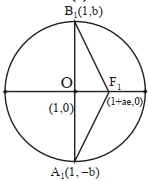
Let an ellipse with centre $(1,0)$ and latus rectum of length $\frac{1}{2}$ have its major axis along $x$-axis. If its minor axis subtends an angle $60^{\circ}$ at the foci, then the square of the sum of the lengths of its minor and major axes is equal to $...........$.
Let $\{x\}$ and $[x]$ denote the fractional part of $x$ and the greatest integer $\leq x$ respectively of a real number $x$. If $\int \limits_{0}^{n}\{x\} d x, \int \limits_{0}^{n}[x] d x$ and $10\left( n ^{2}- n \right),( n \in N , n >1)$ are three consecutive terms of a $G.P.$, then $n$ is equal to
If in a regular polygon the number of diagonals is $54$, then the number of sides of this polygon is
If the point $\left(\alpha, \frac{7 \sqrt{3}}{3}\right)$ lies on the curve traced by the mid-points of the line segments of the lines $x$ $\cos \theta+ y \sin \theta=7, \theta \in\left(0, \frac{\pi}{2}\right)$ between the coordinates axes, then $\alpha$ is equal to