MCQ
$\int_0^{\pi /2} {} (\sin x - \cos x)\log (\sin x + \cos x)\,dx = $
  • A
    $ - 1$
  • B
    $1$
  • $0$
  • D
    None of these

Answer

Correct option: C.
$0$
c
(c) Put $\sin x + \cos x = t \Rightarrow - (\sin x - \cos x)dx = dt$

Also as $x = 0$ to $\frac{\pi }{2},t = 1$ to $1$.

Since here limit is $'1$ to $1'$, 

therefore the value of integral will be zero,

$\left\{ \because \int_{a}^{a}{f(x)dx=0} \right\}$ .

Need a full question paper?

Generate a complete, print-ready paper with questions like this in minutes — across 16+ boards, with answer keys.

Start Generating Free

Similar questions

Choose the correct answer from the given four options.

If $\vec{\text{a}},\vec{\text{b}},\vec{\text{c}}$ are three vectors such that $\vec{\text{a}}+\vec{\text{b}}+\vec{\text{c}}=\vec{0}$ and $|\vec{\text{a}}|=2,|\vec{\text{b}}|=3$ and $|\vec{\text{c}}|=5,$ then the value of $\vec{\text{a}}\cdot\vec{\text{b}}+\vec{\text{b}}\cdot\vec{\text{c}}+\vec{\text{c}}\cdot\vec{\text{a}}$ is:

  1. 0.
  2. 1.
  3. -19.
  4. 38.
If 4a + 2b + c = 0, then the equation 3ax2 + 2bx + c = 0 has atleast one real root lying in the interval:
  1. (0, 1)
  2. (1, 2)
  3. (0, 2)
  4. None of these.
Let $S (x) = \int\limits_{{x^2}}^{{x^3}} \,  ln\, t\, d\, t\, (x > 0)$ and $H (x) = \frac{{S'\,\,(x)}}{x}$. Then $H(x)$ is :
Let $f(x)=2+\cos x$ for all real $x$.

$STATEMENT -1$ : For each real $\mathrm{t}$, there exists a point $\mathrm{c}$ in $[\mathrm{t}, \mathrm{t}+\pi]$ such that $\mathrm{f}^{\prime}(\mathrm{c})=0$. because

$STATEMENT -2$: $f(t)=f(t+2 \pi)$ for each real $t$.
If one of the roots of $\left |\begin{matrix} 3 &\text{amp; 5} &\text{amp; x}\\ 7 &\text{amp; x} &\text{amp; 7}\\ \text{x} &\text{amp; 5} &\text{amp; 3}\end{matrix}\right |=0$ is $-10,$ the other roots are:
  1. 3, 7
  2. 4, 7
  3. 3, 9
  4. 3, 4
For the area bounded by the curve y = ax, the line x = 2 and x - axis to be 2 sq. units, the value of a must be equal to:
  1. 2
  2. 4
  3. 6
  4. 8
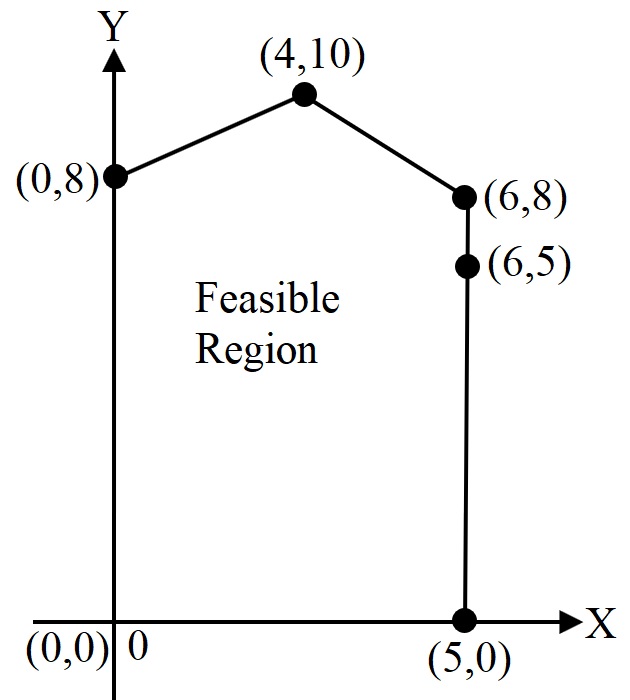
The feasible region for a LPP is shown shaded in the figure. Let Z = 3x - 4y be the objective function. Minimum of Z occurs at.

For an objective function $Z=a x+b y$, where $a, b>0$; the corner points of the feasible region determined by a set of constraints (linear inequalities) are $(0,20),(10,10),(30,30)$ and $(0,40)$. The condition on $a$ and $b$ such that the maximum $Z$ occurs at both the points $(30,30)$ and $(0,40)$ is
The integral $\int {{{\sec }^{2/3}}\,x\,\cos e{c^{4/3}}} x\,dx$ is equal to : (Here $C$ is a constant of integration)
If the points $(0, 1, 2), (2, -1, 3)$ and $(1, -3, 1)$ are the vertices of a triangle, then the triangle is