MCQ
$\int_3^8 {\frac{{2 - 3x}}{{x\sqrt {(1 + x)} }}{\rm{ }}} dx$ is equal to
  • $2\log \,\left( {3/2{e^3}} \right)$
  • B
    $\log (3/{e^3})$
  • C
    $4\log (3/{e^3})$
  • D
    None of these

Answer

Correct option: A.
$2\log \,\left( {3/2{e^3}} \right)$
a
(a) We have $\int_3^8 {\frac{{2 - 3x}}{{x\sqrt {1 + x} }}dx = I} $

Put $1 + x = {t^2} \Rightarrow dx = 2t\,dt$

When $x = 3 \to 8,$ then $t = 2 \to 3$

$\therefore$  $I = 2\int_2^3 {\frac{{5 - 3{t^2}}}{{{t^2} - 1}}dt} $;

$I = 2\int_2^3 {\left( {\frac{2}{{{t^2} - 1}} - 3} \right)} \,dt$

$I = 2\left[ {\frac{2}{{2.1}}\log \frac{{t - 1}}{{t + 1}} - 3t} \right]_2^3$;

$I = 2\log \left( {\frac{3}{{2{e^3}}}} \right)$.

Need a full question paper?

Generate a complete, print-ready paper with questions like this in minutes — across 16+ boards, with answer keys.
Start Generating Free

Similar questions

$\text { If } \int\limits_{0}^{2}\left(\sqrt{2 x}-\sqrt{2 x-x^{2}}\right) d x=$ $\int\limits_{0}^{1}\left(1-\sqrt{1-y^{2}}-\frac{y^{2}}{2}\right) d y+\int\limits_{1}^{2}\left(2-\frac{y^{2}}{2}\right) d y+I$  then $I=\dots\dots\dots$
If the surface area of a sphere of radius $r$ is increasing uniformly at the rate $8\, cm^2/s$, then the rate of change of its volume is
If $f(x) = \frac{{1 - x}}{{1 + x}},$ then $f[f(\cos \;2\theta )] = $
If a drunkard person tries to take a step, then it will be a forward or backward step with probabilities $\frac{1}{4},\frac{1}{2}$ respectively, or he will remain in 'as it is' position. If he tries to take a step $5$ times, then probability that he will be one step away from the initial position
If $\vec{\text{a}},\vec{\text{b}},\vec{\text{c}}$ and $\vec{\text{d}}$ are the position vector of points A, B, C, D such that no three of them are collinear and $\vec{\text{a}}+\vec{\text{c}}=\vec{\text{b}}+\vec{\text{d}}$, then ABCD is a,
  1. Rhombus.
  2. Rectangle.
  3. Square.
  4. Parallelogram.
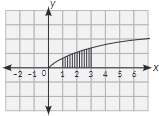
Shown below is the curve defined by the equation $y=\log (x+1)$ for $x \geq 0$.
Image
Which of these is the area of the shaded region?
The derivative of ${\tan ^{ - 1}}\,\sqrt {\frac{{1 - x}}{{1 + x}}} $ with respect to $sin^{-1}x$ is -
Let $f$ be a differentiable function defined on $\left[0, \frac{\pi}{2}\right]$ such that $f(x) > 0$ and $f(x)+\int \limits_0^x f(t) \sqrt{1-\left(\log _e f(t)\right)^2} d t=e, \forall x \in\left[0, \frac{\pi}{2}\right]$ Then $\left(6 \log _{ e } f \left(\frac{\pi}{6}\right)\right)^2$ is equal to $.............$
If $\int\frac{\text{x}^3\text{dx}}{\sqrt{1+\text{x}^2}}=\text{a}(1+\text{x}^2)^{\frac{3}{2}}+\text{b}\sqrt{1+\text{x}^2}+\text{c,}$ then:
  1. $\text{a}=\frac{1}{3},\text{b}=1$
  2. $\text{a}=\frac{-1}{3},\text{b}=1$
  3. $\text{a}=\frac{-1}{3},\text{b}=-1$
  4. $\text{a}=\frac{1}{3},\text{b}=-1$
$\int_{}^{} {\frac{{dx}}{{\sqrt {2x - {x^2}} }} = } $