Question
Integrate the function in Exercise:$\tan^{-1}\sqrt{\frac{1-\text{x}}{1+\text{x}}}$

Answer

$\text{I}=\tan^{-1}\sqrt{\frac{1-\text{x}}{1+\text{x}}}\text{dx}$
$\text{Let x}=\cos\theta\Rightarrow\text{dx}=-\sin\theta\text{d}\theta$
$\text{I}=\int\tan^{-1}\sqrt{\frac{1-\cos\theta}{1+\cos\theta}}(-\sin\theta\text{d}\theta)$
$=-\int^{-1}\sqrt{\frac{2\sin^{2}\frac{\theta}{2}}{2\cos^{2}\frac{\theta}{2}}}\sin\theta\text{d}\theta$
$=-\int\tan^{-1}\tan\frac{\theta}{2}.\sin\theta\text{d}\theta$
$=-\frac{1}{2}\big[\theta.(-\cos\theta)-\int1.(-\cos\theta)\text{d}\theta\big]$
$=-\frac{1}{2}[-\theta\cos\theta+\sin\theta]$
$=+\frac{1}{2}\theta\cos\theta-\frac{1}{2}\sin\theta$
$=\frac{1}{2}\cos^{-1}\text{x}.\text{x}-\frac{1}{2}\sqrt{1-\text{x}^{2}}+\text{C}$
$=\frac{\text{x}}{2}\cos^{-1}\text{x}-\frac{1}{2}\sqrt{1-\text{x}^{2}}+\text{C}$
$=\frac{1}{2}\Big(\text{x}\cos^{-1}\text{x}-\sqrt{1-\text{x}^{2}}\Big)+\text{C}$

Need a full question paper?

Generate a complete, print-ready paper with questions like this in minutes — across 16+ boards, with answer keys.
Start Generating Free

Similar questions

Show that the points $(\hat{\text{i}}-\hat{\text{j}}+3\hat{\text{k}})$ and $3(\hat{\text{i}}+\hat{\text{j}}+4\hat{\text{k}})$ are equidistant from the plane $\vec{\text{r}}\cdot(5\hat{\text{i}}+2\hat{\text{j}}-7\hat{\text{k}})+9=0$ and lies on opposite side of it.
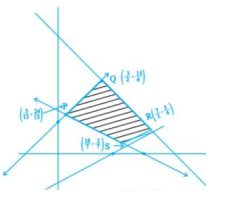
In Fig, the feasible region $($shaded$)$ for a $\text{LPP}$ is shown. Determine the maximum and minimum value of $Z =x+2y$
Image

Solve the Linear Programming Problem graphically:
Maximize $Z = 3x + 4y$ Subject to
$2 x+2 y \leq 80$
$2 x+4 y \leq 120$
For the principal values, evaluate the following:
$\sin^{-1}\Big(-\frac{1}{2}\Big)+2\cos^{-1}\Big(-\frac{\sqrt3}{2}\Big)$
If $x = a (\cos t + t \sin t )$ and $y = a (\sin t - t \cos t )$, then find $\frac{d^2 x}{d t^2}, \frac{d^2 y}{d d^2}$ and $\frac{d^2 y}{d x^2}$.
If $\text{A}=\begin{bmatrix}0&-1&2\\4&3&-4\end{bmatrix}$ and $\text{B}=\begin{bmatrix}4&0\\1&3\\2&6\end{bmatrix},$ then verify that $(\text{kA})'=(\text{kA}').$
Write the angle between the curves $y^2 = 4x$ and $x^2 = 2y - 3$ at the point $(1, 2).$
Let $R^+$ be the set of all non$-$negative real numbers. If $f : R^+ \rightarrow R^+$ and $g : R^+ \rightarrow R^+$ are defined as $f(x) = x^2$ and $\text{g(x)}=+\sqrt{\text{x}},$ find $fog$ and $gof.$ Are they equal functions?
Let $A = R_0 \times R,$ where $R_0$ denote the set of all non$-$zero real numbers. A binary operation $'⊙\ ' $is defined on $A$ as follows:
$(a, b) ⊙ (c, d) = (ac, bc + d)$ for all $(a, b), (c, d) \in R_0 \times R.$
Show that $'⊙\ '$ is commutative and associative on $A.$
If $\text{A}=\begin{bmatrix} \cos\theta & \sin\theta \\ -\sin\theta & \cos\theta \end{bmatrix}\text{ and A (adj A =)}\begin{bmatrix} \text{k} & 0 \\ 0 & \text{k} \end{bmatrix},$ then find the value of $k.$
Evalute the following integrals:
$\int\sqrt{\frac{1-\sin2\text{x}}{1+\sin2\text{x}}}\text{dx}$