MCQ
Intensity of $X$-rays depends upon the number of
  • Electrons
  • B
    Protons
  • C
    Neutrons
  • D
    Positrons

Answer

Correct option: A.
Electrons
Intensity of $X$-rays depends upon the number of electron striking the target.

Need a full question paper?

Generate a complete, print-ready paper with questions like this in minutes — across 16+ boards, with answer keys.
Start Generating Free

Similar questions

The displacement $x$ of a particle moving in one dimension under the action of a constant force is related to the time $t$ by the equation $t=\sqrt{x}+3$, where $x$ is in meters and $t$ is in seconds. The work done by the force in the first $6$ seconds is
If $C_V=4.96 \mathrm{cal} /$ mole $K$, then increase in internal energy when temperature of $2$ moles of this gas is increased from $340 K$ to $342 K$
A potential barrier of $0.50 \quad V$ exists across a $P-N$ junction. If the depletion region is $5.0 \times 10^{-7} m$ wide, the intensity of the electric field in this region is
The position vectors of radius are $2 \hat{i}+\hat{j}+\hat{k}$ and $2 \hat{i}-3 \hat{j}+\hat{k}$ while those of linear momentum are $2 \hat{i}+3 \hat{j}-\hat{k}$. Then the angular momentum is
The value of escape velocity on a certain planet is $2 \mathrm{~km} / \mathrm{s}$. Then the value of orbital speed for a satellite orbiting close to its surface is
In a photocell bichromatic light of wavelength $2475 \mathring A$ and $6000 \mathring A$ are incident on cathode whose work function is $4.8 \mathrm{eV}$. If a uniform magnetic field of $3 \times 10$. Tesla exists parallel to the plate, the radius of the path describe by the photoelectron will be (mass of electron = $9 \times 10 \cdot \mathrm{kg}$ )
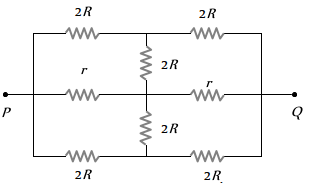
The effective resistance between points $P$ and $Q$ of the electrical circuit shown in the figure is

Image

The refractive index of water is $4 / 3$ and that of glass is $5 / 3$. What will be the critical angle for the ray of light entering water from the glass
The masses and radii of the earth and moon are $M_1, R_1$ and $M_2, R_2$ respectively. Their centres are distance $d$ apart. The minimum velocity with which a particle of mass $m$ should be projected from a point midway between their centres so that it escapes to infinity is
A uniform chain of length $L$ and mass $M$ is lying on a smooth table and one third of its length is hanging vertically down over the edge of the table. If $g$ is acceleration due to gravity, the work required to pull the hanging part on to the table is