MCQ
$\int\limits_0^{\frac{\pi }{2}} {\,\,\frac{{d\,x}}{{{{\cos }^6}x + \,{{\sin }^6}\,x}}}$  is equal to :
  • A
    zero
  • $\pi$
  • C
    $\pi /2$
  • D
    $2 \pi $

Answer

Correct option: B.
$\pi$
b
$I = \int\limits_0^{\frac{\pi }{2}} {\,\,\frac{{d\,x}}{{1\,\, - \,\,3\,{{\sin }^2}\,x\,\,{{\cos }^2}\,x}}}$

 $= \int\limits_0^{\frac{\pi }{2}} {\,\,\frac{{d\,x}}{{1\,\, - \,\,{\textstyle{3 \over 4}}\,{{\sin }^2}\,2x}}}$ 

$= 2 \int\limits_0^\pi  {\,\,\frac{{d\,t}}{{4\,\, - \,\,3\,{{\sin }^2}\,t}}}$

where $2x = t$

$= 4 \, \int\limits_0^{\frac{\pi }{2}} {\,\,\frac{{d\,t}}{{4\,\, - \,\,3\,{{\sin }^2}\,t}}}$ etc.

Need a full question paper?

Generate a complete, print-ready paper with questions like this in minutes — across 16+ boards, with answer keys.
Start Generating Free

Similar questions

Order of the differential equation of the family of all concentric circles centered at $(h, k)$ is
Choose the correct answer from the given four options.
If A and B are two events such that $\text{P}(\text{A})=\frac{1}{2},\text{P}(\text{B})=\frac{1}{3},$ $\text{P}\Big(\frac{\text{A}}{\text{B}}\Big)=\frac{1}{4},$ then $\text{P}(\text{A}'\cap\text{B}')$ equals:
  1. $\frac{1}{12}$
  2. $\frac{3}{4}$
  3. $\frac{1}{4}$
  4. $\frac{3}{16}$
If A and B are two events such that $\text{P(A)}\neq0$ and $\text{P(B)}\neq1,$ then $\text{P}(\overline{\text{A}}|\overline{\text{B}})=$
Let * be a binary operation defined on set Q − {1} by the rule a * b = a + b − ab. Then, the identify element for * is:
  1. $1$
  2. $\frac{\text{a}-1}{\text{a}}$
  3. $\frac{\text{a}}{\text{a}-1}$
  4. $0$
$\cos\Big(2\tan^{-1}\frac{1}{7}\Big)-\sin\Big(4\sin^{-1}\frac{1}{3}\Big)=$
  1. $1$
  2. $0$
  3. $\frac{1}{2}$
  4. $-\frac{1}{2}$
For linear programming problem the objective function $Z=8000 x+12000 y$, if the corner points of the feasible region are $(0,0),(20,0),(12,6)$ and $(0,10)$, then maximum value of $Z$ occur at _________ corner point.
Let $\lambda $ be a real number for which the system of linear equations $x + y + z = 6$
 ; $4x + \lambda y - \lambda z = \lambda - 2$ ; $3x + 2y -4z = -5$ Has indefinitely many solutions. Then $\lambda $ is a root of the quadratic equation
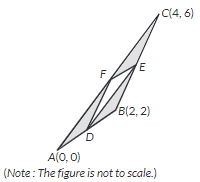
The points $D, E$ and $F$ are the mid-points of $A B, B C$ and $C A$ respectively.
Image
What is the area of the shaded region?
The probabilities of a student getting I, II and III division in an examination are $\frac{1}{10},\frac{3}{5}$ and $\frac{1}{4}$ respectively. The probability that the student fails in the examination is.
The differential equation $x{\left( {\frac{{{d^2}y}}{{d{x^2}}}} \right)^3} + {\left( {\frac{{dy}}{{dx}}} \right)^4} + y = {x^2}$ is of