MCQ
$\int\limits_0^{4\,/\,\pi } {} $ $\left( {3\,{x^2}\,\,.\,\,\sin \,\frac{1}{x}\,\, - \,\,x\,\,.\,\,\cos \,\frac{1}{x}} \right)$ $dx$  has the value :
  • A
    $\frac{{8\,\sqrt 2 }}{{{\pi ^3}}}$
  • B
    $\frac{{24\,\sqrt 2 }}{{{\pi ^3}}}$
  • $\frac{{32\,\sqrt 2 }}{{{\pi ^3}}}$
  • D
    None

Answer

Correct option: C.
$\frac{{32\,\sqrt 2 }}{{{\pi ^3}}}$
c
Consider $\int\limits_0^{\frac{4}{\pi }} {3{x^2}\,\sin \frac{1}{x}dx} $ and $IBP $ taking as the $1^{st}$ and $3x^2$ as the $2^{nd} $ function.

Two integrals cancel
$\int {\,\,\left( {3{x^2}\underbrace {\sin \frac{1}{x}}_I - x\cos \frac{1}{x}} \right)\,dx} $

$=\sin \frac{1}{x}\,\cdot\,{x^3}$$-\int {\cos \frac{1}{x}\left( { - \frac{1}{{{x^2}}}} \right){x^3}\,dx} $$-\int {x{{\cos }^2}\frac{1}{x}\,dx} $

=$\left. {{x^3}\,\cdot\,\sin \frac{1}{x}} \right|_{\,0}^{\frac{4}{\pi }}$

Need a full question paper?

Generate a complete, print-ready paper with questions like this in minutes — across 16+ boards, with answer keys.

Start Generating Free

Similar questions

Let f : R → R be a function defined by $\text{f(x)}=\frac{\text{e}^{|\text{x}|}-\text{e}^{-\text{x}}}{\text{e}^{\text{x}}+\text{e}^{-\text{x}}}.$ Then,
  1. f is a bijection.
  2. f is an injection only.
  3. f is surjection on only.
  4. f is neither an injection nor a surjection.
The solution of the differential equation, $(x + 2y^3) \frac{{dy}}{{dx}} = y$ is :
Suppose that $f (0) = - 3$ and $f ' (x) \le 5$ for all values of $x$. Then the largest value which $f (2)$ can attain is
The value of $\tan \left[ {{{\sin }^{ - 1}}\left( {\frac{3}{5}} \right) + {{\cos }^{ - 1}}\left( {\frac{3}{{\sqrt {13} }}} \right)} \right]$is
If $y = 3[x] + 1 = 4[x -1] -10$, then $[x + 2y]$ is equal to (where $[.]$ is $G.I.F.$)
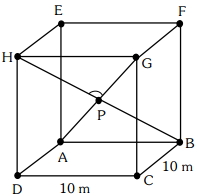
A hall has a square floor of dimension $10\, \mathrm{~m} \times 10\, \mathrm{~m}$ (see the figure) and vertical walls. If the angle $GPH$ between the diagonals $\mathrm{AG}$ and $\mathrm{BH}$ is $\cos ^{-1} \frac{1}{5}$, then the height of the hall (in $meters$) is :
If $f: R \rightarrow R$ is given by $f(x)=x+1$, then the value of $\lim _{n \rightarrow \infty} \frac{1}{n}\left[f(0)+f\left(\frac{5}{n}\right)+f\left(\frac{10}{n}\right)+\ldots+f\left(\frac{5(n-1)}{n}\right)\right]$, is:
Let $y=y(x)$ be a solution of the differential equation $(x \cos x) d y+(x y \sin x+y \cos x-1) d x=0$, $0 < x < \frac{\pi}{2}$. If $\frac{\pi}{3} y\left(\frac{\pi}{3}\right)=\sqrt{3}$, then $\left|\frac{\pi}{6} y^{\prime \prime}\left(\frac{\pi}{6}\right)+2 y^{\prime}\left(\frac{\pi}{6}\right)\right|$ is equal to $.........$.
The differential equation obtained on eliminating A and B from $\text{y}=\text{A}\cos\omega\text{t}+\text{B}\sin\omega\text{t}$ is:
  1.   $\text{y}''+\text{y}'=0$
  2. $\text{y}''-\omega^{2}\text{y}=0$
  3. $\text{y}''=-\omega^{2}\text{y}=0$
  4. $\text{y}''+\text{y}=0$ 
The area bounded by curves $y = 1 - cos(\pi x),y = - x^2$ and the line $x = \frac{1}{2}$ and $x = -\frac{1}{2}$ is