MCQ
$\int\frac{\text{e}^{\text{x}}(1+\text{x})}{\cos^2(\text{x}\text{e}^{\text{x}})}\text{ dx}=$
  • A
    $2\log_\text{e}\cos(\text{xe}^{\text{x}})+\text{C}$
  • B
    $\sec(\text{xe}^{\text{x}})+\text{C}$
  • $\tan(\text{xe}^{\text{x}})+\text{C}$
  • D
    $\tan(\text{x}+\text{e}^{\text{x}})+\text{C}$
Answer

Correct option: C.
$\tan(\text{xe}^{\text{x}})+\text{C}$
$\text{I}=\int\frac{\text{e}^{\text{x}}(1+\text{x})}{\cos^{2}(\text{xe}^{\text{x}})}\text{ dx}$
Put $\text{xe}^{\text{x}}=\text{t}$
$\text{e}^{\text{x}}(1+\text{x})\text{dx}=\text{dt}$
$\text{I}=\int\frac{\text{dt}}{\cos^2\text{t}}$
$=\text{I}=\int\sec^2\text{t dt}$
$\text{t}=\tan\text{t}+\text{C}$
$\text{I}=\tan(\text{xe}^{\text{x}})+\text{C}$

Need a full question paper?

Generate a complete, print-ready paper with questions like this in minutes — across 16+ boards, with answer keys.

Start Generating Free

Similar questions

If the differential equation representing the family of all circles touching $x-$ axis at the origin is $\left( {{x^2} - {y^2}} \right)\frac{{dy}}{{dx}} = g\left( x \right)y$ , then $g(x)$ equals
The position vector of a point at a distance of $3\sqrt {11} $ units from $i - j + 2k$ on a line passing through the points $i - j + 2k$ and $3i + j + k$ is
If matrix $A=\left[a_{i j}\right]_{m \times n}$ is a square matrix, then
The number of distinct real roots of the equation $3 x^{4}+4 x^{3}-12 x^{2}+4=0$ is ..... .
Let $A=\left[\begin{array}{l}a_{1} \\ a_{2}\end{array}\right]$ and $B=\left[\begin{array}{l}b_{1} \\ b_{2}\end{array}\right]$ be two $2 \times 1$ matrices with real entries such that $A = XB,$

where $X=\frac{1}{\sqrt{3}}\left[\begin{array}{cc}1 & -1 \\ 1 & k\end{array}\right],$ and $k \in R$. If $a _{1}^{2}+ a _{2}^{2}=\frac{2}{3}\left( b _{1}^{2}+ b _{2}^{2}\right)$ and $\left( k ^{2}+1\right) b _{2}^{2} \neq-2 b _{1} b _{2}$ then the value of $k$ is ....... .

If a function $\text{f}:[2,\infty)\rightarrow\ \text{B}$ defined by $f(x) = x^2 - 4x + 5$ is a bijection, then $B =$
If $x = {t^2}$, $y = {t^3}$, then ${{{d^2}y} \over {d{x^2}}} =$
The area of a triangle whose vertices are $A\,(1,\, - 1,\,2),$ $B\,(2,\,1,\, - 1)$ and $C\,(3,\, - 1,\,2)$ is
From which of the following the distance of the point $(1,\,\,2,\,\,3)$ is $\sqrt {10} $
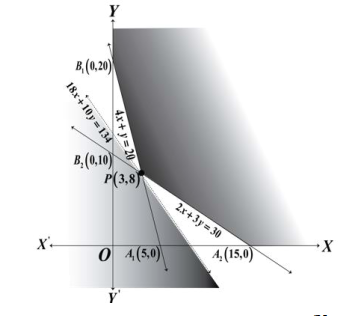
A linear programming problem (LPP) along eith the graph of its constraints is shown below.The correspondig objective function is :Z = 18x + 10y which has to be minimized. The smallest value of the objective function Z is 134 and is obtained at the corner point (3,8).
Image
The optimal solution of the above linear programming problem_______________.