MCQ
$\int\text{e}^{\text{x}}\{\text{f(x)}+\text{f}'(\text{x})\}\text{dx}=$
  • $\text{e}^{\text{x}}\text{f(x)}+\text{C}$
  • B
    $\text{e}^{\text{x}}+\text{f(x)}$
  • C
    $2\text{e}^{\text{x}}\text{f(x)}$
  • D
    $\text{e}^{\text{x}}-\text{f(x)}$

Answer

Correct option: A.
$\text{e}^{\text{x}}\text{f(x)}+\text{C}$
$\int\text{e}^{\text{x}}\{\text{f(x)}+\text{f}'(\text{x})\}\text{dx}=\text{e}^{\text{x}}\text{f(x)}+\text{C}$

Need a full question paper?

Generate a complete, print-ready paper with questions like this in minutes — across 16+ boards, with answer keys.
Start Generating Free

Similar questions

If the function $f(x)=\left\{\begin{array}{ll}k_{1}(x-\pi)^{2}-1, & x \leq \pi \\ k_{2} \cos x, & x>\pi\end{array}\right.$ is twice differentiable, then the ordered pair $\left( k _{1}, k _{2}\right)$ is equal to
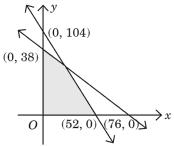
The feasible region of an LPP is given in the following figure
Image
Then, the constraints of the LPP are $x \geq 0, y \geq 0$ and
If $a = i + 2j - 2k,\,\,b = 2i - j + k$and $c = i + 3j - k,$ then $a \times (b \times c)$ is equal to
Which of the following is not a vector quantity:
The maximum value of $12\,\,  sin\theta\,\, -\,\,  9\,\,  sin^2\theta$ is
Corner points of the feasible region determined by the system of linear constraints are (0, 3), (1, 1) and (3, 0). Let Z = px + qy, where p, q > 0. Condition on p and q so that the minimum of Z occurs at (3, 0) and (1, 1) is:
Choose the correct answer in the following. Area bounded by the curve $y = x^3,$ the $x-$ axis and the ordinates $x = –2$ and $x = 1$ is :
Choose the correct option from given four options:
If $\int\frac{\text{dx}}{(\text{x}+2)(\text{x}^2+1)}=\text{a}\log|1+\text{x}^2|+\text{b}\tan^{-1}\text{x}+\frac{1}{5}\log|\text{x}+2|+\text{C},$ then:
Two cards are drawn one by one from a pack of cards. The probability of getting first card an ace and second a coloured one is (before drawing second card first card is not placed again in the pack)
Choose the correct answer from the given four option. 
The integrating factor of the differential equation $\frac{\text{d}\text{y}}{\text{d}\text{x}}+\text{y}=\frac{1+\text{y}}{\text{x}}$ is: