MCQ
Iodine dissolves readily in
  • A
    Water
  • Potassium iodide
  • C
    Carbon tetrachloride
  • D
    Alcohol

Answer

Correct option: B.
Potassium iodide
b
(b) $KI + {I_2}\,\, \to \mathop {K{I_3}}\limits_{{\rm{(soluble}}\,\,{\rm{complex)}}} $

Need a full question paper?

Generate a complete, print-ready paper with questions like this in minutes — across 16+ boards, with answer keys.
Start Generating Free

Similar questions

Dimerisation in carboxylic acid is due to
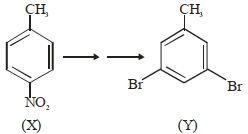
In the above conversion of compound $( X )$ to product $(Y)$, the sequence of reagents to be used will be:
Which of the following is a true solution?
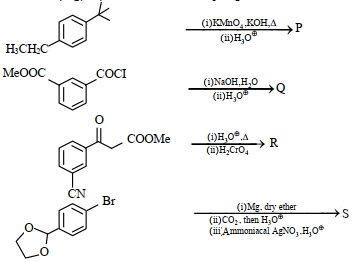
In the following reactions, $P, Q, R$, and $S$ are the major products.

The correct statement ($s$) about $P, Q, R$, and $S$ is (are)

($A$) $P$ and $Q$ are monomers of polymers dacron and glyptal, respectively.

($B$) $P, Q$, and $R$ are dicarboxylic acids.

($C$) Compounds $Q$ and $R$ are the same.

($D$) $R$ does not undergo aldol condensation and $S$ does not undergo Cannizzaro reaction.
Which of the following reaction is called as ‘Bouveault-Blanc reduction’
Which of the following acids forms three series of salts?
Aniline reacts with sodium nitrite and hydrochloric acid at 273-278K to give:
Among $TiF^{2-}_6 ,CoF^{3-}_6 ,Cu_2Cl_2$ and $NiCl^{2-}_4$ the colourless species  are 
An amino acid may be represented by general formula $\begin{matrix}
   R\,\,\,\,\,\,\,\,  \\
   |\,\,\,\,\,\,\,\,  \\
   {{H}_{2}}N-CH-COOH  \\
\end{matrix}$ If $R = -CH_2C_6H_5$ then it is phenylalanine $(Phe)$ and if $R = CH_3$ then it is alanine $(Ala)$. Find the sequence of reagents from those given below to synthesize $Phe- Ala$

$(1)$ $\begin{matrix}
   C{{H}_{3}}  \\
   |\,\,\,\,\,\,  \\
   ZNH\,C\,HC{{O}_{2}}H  \\
\end{matrix}$                             $(2)$ $\begin{matrix}
   C{{H}_{3}}\,\,\,\,\,\,\,\,\,\,\,\,\,\,\,\,\,\,\,\,  \\
   |\,\,\,\,\,\,\,\,\,\,\,\,\,\,\,\,\,\,\,\,\,\,\,\,\,\,\,\,  \\
   {{H}_{2}}N\,C\,HC{{O}_{2}}C{{H}_{2}}{{C}_{6}}{{H}_{5}}  \\
\end{matrix}$

$(3)$ $\begin{matrix}
   \,\,\,\,\,\,\,\,\,\,\,\,C{{H}_{3}}{{C}_{6}}{{H}_{5}}  \\
   |\,\,\,\,\,  \\
   ZNH\,C\,HC{{O}_{2}}H  \\
\end{matrix}$                $(4)$ $\begin{matrix}
   C{{H}_{2}}{{C}_{6}}{{H}_{5}}\,\,\,\,\,  \\
   |\,\,\,\,\,\,\,\,\,\,\,\,\,\,\,\,\,\,\,\,\,\,\,\,\,\,\,  \\
   {{H}_{2}}N\,CHC{{O}_{2}}C{{H}_{2}}{{C}_{6}}{{H}_{5}}  \\
\end{matrix}$

The activation energy for a simple chemical reaction $A \to B$ is ${E_a}$ in forward direction. The activation energy for reverse reaction