MCQ
Iodine molecules are held in the solid lattice by ...................
  • A
    London forces
  • B
    dipole-dipole interactions
  • C
    covalent bonds
  • D
    coulombic force

Answer

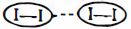
$(a)$ London forces between two $I_2$ molecules in solid lattice.

Need a full question paper?

Generate a complete, print-ready paper with questions like this in minutes — across 16+ boards, with answer keys.

Start Generating Free

Similar questions

One part of an element $A$ combines with two parts of another $B$ . Six parts of the element $C$ combine with four parts of the element $B$ . if $A$ and $C$ combine together the ratio of their weights will be governed by
The most volatile alkane is
In neutral or faintly alkaline medium, $KMnO _{4}$ being a powerful oxidant can oxidize, thiosulphate almost quantitatively, to sulphate. In this reaction overall change in oxidation state of manganese will be
$2$ moles of $PC{l_5}$ were heated in a closed vessel of $2$ litre capacity. At equilibrium, $40\%$ of $PC{l_5}$ is dissociated into $PC{l_3}$ and $C{l_2}$. The value of equilibrium constant is
The alcohol which show turbidity immediate when reacted with $(HCl + ZnCl_2)$
Electrical conductance through metals is called metallic or electronic conductance and is due to the movement of electrons. The electronic conductance depends on
The products formed in the following reaction are ${{C}_{6}}{{H}_{5}}-O-C{{H}_{3}}+HI\xrightarrow{\text{heat}}$
In the reaction $H_2 + O_2 \to H_2O$. If $6\,g$ of $H_2$ combines with $64\,g$ of $O_2$. Find mass of Excess reagent Left ? ............. $\mathrm{g}$
The molar heat capacity of water at constant pressure is $75\, JK^{-1}\, mol^{-1}$. When $1\,kJ$ of heat is supplied to $100\, g$ of water, which is free to expand, the increase in temperature of water is ............... $K$
benzene $+ HN{O_{3\left( {conc.} \right)}}\xrightarrow{{{H_2}S{O_4}}}A\xrightarrow[{\left( {ii} \right)\,O{H^ - }}]{{\left( i \right)\,Sn/HCl}}B\xrightarrow[{0 - 5{\,^o}C}]{{NaN{O_2} + HCl}}C\xrightarrow{{{H_2}O/{H^ + }}}D$ What is $D$