MCQ
Ionic compounds are formed most easily with
  • A
    Low electron affinity, high ionisation energy
  • High electron affinity, low ionisation energy
  • C
    Low electron affinity, low ionisation energy
  • D
    High electron affinity, high ionisation energy

Answer

Correct option: B.
High electron affinity, low ionisation energy
b
(b) The formation of ionic bond depends upon easy formation of cation and anion. therefore the ionisation energy value of the metal atom should be low,

so that it can easily form cation. on the other hand, the electron affinity value of the non-metal atom should be high so that it can easily form anion.

Need a full question paper?

Generate a complete, print-ready paper with questions like this in minutes — across 16+ boards, with answer keys.

Start Generating Free

Similar questions

Which of the following elements is found in native state
Which of the following property displays progressive increase with the rise in atomic number across a period in the periodic table
In the preparation of alkanes; a concentrated aqueous solution of sodium or potassium salts of saturated carboxylic acid are subjected to
Which of the following statements about the electron is incorrect?
Match List $I$ with List $II$. Choose the correct answer from the options given below:

List $-I$ List $-II$

$A.$ Melting point $[\mathrm{K}]$ 

$I.$ $\mathrm{Tl}>\mathrm{In}>\mathrm{Ga}>\mathrm{Al}>\mathrm{B}$

$B.$ Ionic Radius $\left[\mathrm{M}^{+3} / \mathrm{pm}\right]$

$II.$ $\mathrm{B}>\mathrm{Tl}>\mathrm{Al} \approx \mathrm{Ga}>\mathrm{In}$
$C.$ $\Delta_{\mathrm{i}} \mathrm{H}_1 $ $ [\mathrm{~kJ} \mathrm{~mol}^{-1}]$ $III.$ $\mathrm{Tl}>\mathrm{In}>\mathrm{Al}>\mathrm{Ga}>\mathrm{B}$
$D.$ Atomic Radius $[pm]$ $IV.$ $\mathrm{B}>\mathrm{Al}>\mathrm{Tl}>\mathrm{In}>\mathrm{Ga}$
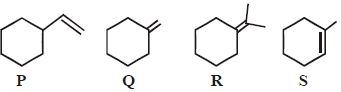
Arrange the following alkenes in increasing order of their enthalpy of hydrogenation $(-\Delta H)$
Identify the which can exhibit tautomerism ?
What mass of $95\, \%$ pure $CaCO _{3}$ will be required to neutralise $50 \,mL$ of $0.5\, M \,HCl$ solution according to the following reaction? (In $g$)

$CaCO _{3( s )}+2 HCl _{( aq )} \rightarrow CaCl _{2( aq )}+ CO _{2( g )}+2 H _{2} O _{( l )}$

[Calculate upto second place of decimal point]

What is the final temperature of $0.10\,mole$ monoatomic ideal gas that performs $75\,cal$ of work adiabatically if the initial temperature is $227\,^oC$ ?....$K$ (use $R = 2\,cal/K-mol$ ) 
Which of the following diagrams shows correct change in the polarity of bond ?