Question
Iron exhibits $+2$ and $+3$ oxidation states. Write their electronic configuration. Which will be more stable? Why?

Answer

The electronic configuration of $Fe ^{2+}$ and $Fe ^{3+}$ :
$Fe^{2+}: Is^2 2 s^2 2 p^6 3 s^2 3 p^6 3 d^6$
$Fe ^{3+}$ : Is $s^2 2 s^2 2 p^6 3 s^2 3 p^6 3 d^5$ Due to loss of two electrons from the $4 . v$-orbital and one electron from the $3 d$-orbital, iron attains $3^{+}$oxidation state.
Since in
$Fe ^{3+}$, the 3 d -orbital is half-filled, it gets extra stability, hence $Fe ^{3+}$ is more stable than $Fe ^{2+}$.

Need a full question paper?

Generate a complete, print-ready paper with questions like this in minutes — across 16+ boards, with answer keys.

Start Generating Free

Similar questions

What are missing entries?
Formula Name
$XeOF_2$
……………
$XeO_3F_2​​​​​​​$​​​​​​​
$XeO_2F_4​​​​​​​$​​​​​​​
Xenon monooxyfluoride
Xenon dioxydifluoride
……………………………………..
……………………………………..
Give the structures of the following :
Write the names of group 18 elements and their electronic configuration.
What are semiconductors ? Mention the types of semiconductors.
What are the requirements for the colliding reactant molecules to lead to products?
From the rate expressions for the following reactions, determine their order :
(a) $2 N _2 O _{5( g )} \rightarrow 4 NO _{2( g )}+ O _{2( g )}:$ Rate $= k \left[ N _2 O _5\right]$
(b) $CHCl _{3( g )}+ Cl _{2( g )} \rightarrow CCl _{4( g )}+ HCl _{( g )}:$ Rate $= k \left[ CHL _3\right]\left[ Cl _2\right]^{1 / 2}$
(c) $C _2 H _5 Cl _{( g )} \rightarrow C _2 H _{4( g )}+ HCl _{( g )}$ : Rate $= k \left[ C _2 H _5 Cl \right]$
(d) $2 NO _{2( g )}+ F _{2( g )} \rightarrow 2 NO _2 F _{( g )} \rightarrow$ : Rate $= k \left( NO _2\right]\left[ F _2\right]$
Define and explain the term molecularity of a reaction. Give examples.
###
Define the molecularity of a chemical reaction.
What is the action of Grignard reagent, $CH _3- Mg - I$ on : (1) formaldehyde (2) acetone?
How is ethylamine prepared from (a) Nitro-alkane (b) Oxime?
Explain basic nature of amines.
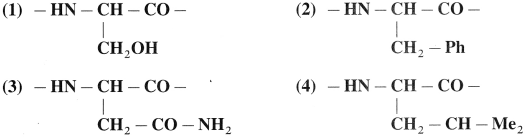
A protein chain has the following amino acid residues. Show and label the interactions that can be present in various pairs from these giving rise to tertiary level structure of protein.

Image