MCQ
Iron is
- AA normal element
- BA typical element
- ✓A transitional element
- DAn inert element
Generate a complete, print-ready paper with questions like this in minutes — across 16+ boards, with answer keys.
$\begin{gathered}
{\left[ {Al{{\left( {{H_2}O} \right)}_6}} \right]^{ + 3}} + HCO_3^ - \rightleftarrows {\left[ {Al{{\left( {{H_2}O} \right)}_5}OH} \right]^{ + 2}} + {H_2}C{O_3} \hfill \\
\,\,\,\,\,\,\,\,\,\,\,\,(A)\,\,\,\,\,\,\,\,\,\,\,\,\,\,\,\,\,\,\,\,(B)\,\,\,\,\,\,\,\,\,\,\,\,\,\,\,\,\,\,\,\,\,\,\,\,\,\,\,\,\,\,\,\,\,\,\,\,\,(C)\,\,\,\,\,\,\,\,\,\,\,\,\,\,\,\,\,\,\,\,\,\,\,(D) \hfill \\
\end{gathered} $
species behaving as bronsted -lowry acid are
$(A)$ $n=4,1=1$ $(B)$ $\mathrm{n}=4,1=2$ $(C)$ $\mathrm{n}=3,1=1$ $(D)$ $\mathrm{n}=3,1=2$ $(E)$ $n=4,1=0$
Choose the correct answer from the options given below:
(image)
The transition temperature for $\alpha$ to $\beta$ phase change is $600 \mathrm{~K}$ and $C_{p, \beta}-C_{p, \alpha}=1 \mathrm{~J} \mathrm{~mol}^{-1} \mathrm{~K}^{-1}$. Assume $\left(C_{p, \beta}-C_{p, \alpha}\right)$ is independent of temperature in the range of 200 to $700 \mathrm{~K} . \mathrm{C}_{p, \alpha}$ and $C_{p, \beta}$ are heat capacities of $\alpha$ and $\beta$ phases, respectively.
($1$)The value of entropy change, $\mathrm{S}_\beta-\mathrm{S}_\alpha$ (in $\mathrm{J} \mathrm{mol}^{-1} \mathrm{~K}^{-1}$ ), at $300 \mathrm{~K}$ is. . . . . . .
[Use : $\ln 2=0.69$ Given : $S_\beta-S_\alpha=0$ at $\left.0 \mathrm{~K}\right]$
($2$) The value of enthalpy change, $\mathrm{H}_\beta-\mathrm{H}_\alpha$ (in $J$ mol ${ }^{-1}$ ), at $300 \mathrm{~K}$ is
Give the answer quetion ($1$) and ($2$)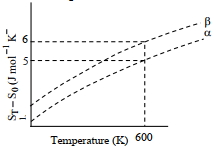
Assertion $(A)$: Cis form of alkene is found to be more polar than the trans form
Reason $(R)$: Dipole moment of trans isomer of $2$-butene is zero.
In the light of the above statements, choose the correct answer from the options given below :