MCQ
Irreversible process is
  • A
    Adiabatic process
  • Joule-Thomson expansion
  • C
    Ideal isothermal process
  • D
    None of the above

Answer

Correct option: B.
Joule-Thomson expansion
b
The method of expansion in which a gas or liquid at pressure $P_1$ flows into a region of lower pressure $P_2$ without significant change in kinetic energy, is called the Joule-Thomson expansion. The expansion is inherently irreversible.

Need a full question paper?

Generate a complete, print-ready paper with questions like this in minutes — across 16+ boards, with answer keys.
Start Generating Free

Similar questions

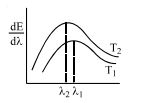
The spectral emissive power $E_\lambda $ for a body at temperature $T_1$ is plotted against the wavelength and area under the curve is found to be $A$. At a different temperature $T_2$ the area is found to be $9A$. Then $\lambda _1/\lambda _2 =$
A particle is moving in a straight line such that its velocity is increasing at $5\,ms ^{-1}$ per meter. The acceleration of the particle is $ms ^{-2}$ at a point where its velocity is $20\,ms ^{-1}$.
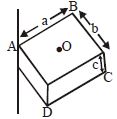
Figure shows a uniform solid block of mass $M$ and edge lengths $a, b$ and $c$. Its $M.I.$ about an axis through one edge and perpendicular (as shown) to the large face of the block is
A wall clock uses a vertical spring-mass system to measure the time. Each time the mass reaches an extreme position, the clock advances by a second. The clock gives correct time at the equator. If the clock is taken to the poles it will:
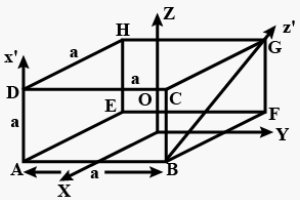
With reference to of a cube of edge a and mass $m,$ state whether the following are true or false. $(O$ is the centre of the cube.$)$
Image
  1. The moment of inertia of cube about $z-$axis is $\text{I}_\text{x}=\text{I}_\text{x}+\text{I}_\text{y}$
  2. The moment of inertia of cube about $z′$ is $\text{I}'_\text{z}=\text{I}_\text{z}+\frac{\text{ma}^2}{2}$
  3. The moment of inertia of cube about $z"$ is $\text{I}{''}_{\text{z}}=\text{I}_2+\frac{\text{ma}^2}{2}$
  4. $\text{I}_\text{x}=\text{I}_\text{y}$
Applying the principle of homogeneity of dimensions, determine which one is correct. where $\mathrm{T}$ is time period, $\mathrm{G}$ is gravitational constant, $M$ is mass, $r$ is radius of orbit.
The path Difference between the two waves ${y_1} = {a_1}\,\sin \,\left( {\omega t - \frac{{2\pi x}}{\lambda }} \right)$ and ${y_2} = {a_2}\,\cos \,\left( {\omega t - \frac{{2\pi x}}{\lambda } + \phi } \right)$ is
A force of $19.6\, N$ when applied parallel to the surface just moves a body of mass $10 \,kg$ kept on a horizontal surface. If a $5\, kg$ mass is kept on the first mass, the force applied parallel to the surface to just move the combined body is........ $N.$ 
If we can throw a ball upto a maximum height $H$, the maximum horizontal distance to which we can throw it is
A boat at anchor is rocked by waves whose crests are $100\, m$ apart and velocity is $25\, m/sec$. The boat bounces up once in every: ...  $sec$