Question
Is a 'single isolated force' possible in nature?

Answer

A single isolated force is not possible. This follows from Newton's third law of motion, according to which to every action, there is an equal and opposite reaction. So, the forces must always exist in pairs. When we talk of a single force, we are considering only one aspect of mutual interaction.

Need a full question paper?

Generate a complete, print-ready paper with questions like this in minutes — across 16+ boards, with answer keys.
Start Generating Free

Similar questions

If an electron has a wavelength, does it also have a colour?
The metre is defined as the distance travelled by light in $\frac{1}{299,792,458}$ second. Why didn't people choose some 1 easier number such as $\frac{1}{300,000,000}$ second? Why not 1 second?
A body of mass 0.5 kg travels in a straight line with velocity $v=a x^{3 / 2}$ where $a=5 m^{-1 / 2} s^{-1}$. What is the work done by the net force during its displacement from $x=0$ to $x=2 m$ ?
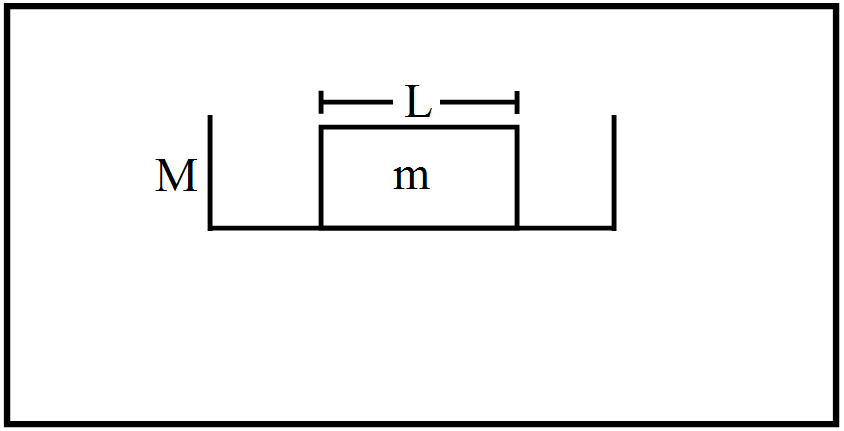
Consider a gravity-free hall in which a tray of mass M, carrying a cubical block of ice of mass m and edge L, is at rest in the middle. If the ice melts, by what distance does the centre of mass of "the tray plus the ice" system descend?

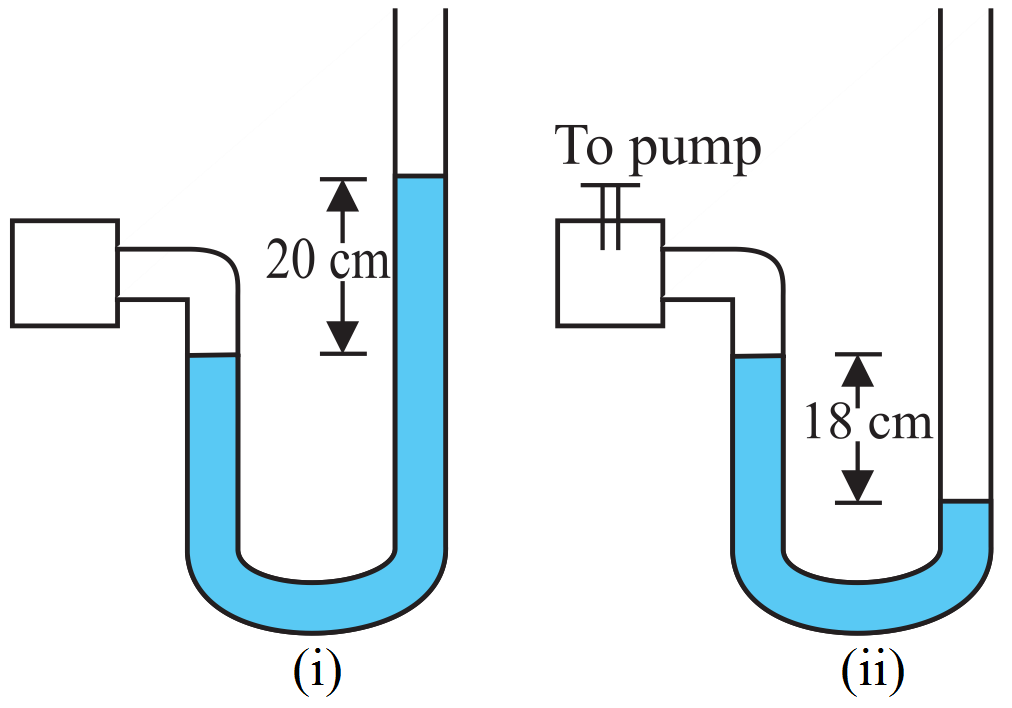
A manometer reads the pressure of a gas in an enclosure as shown in Fig.(a) When a pump removes some of the gas, the manometer reads as in Fig. (b) The liquid used in the manometers is mercury and the atmospheric pressure is 76cm of mercury.
Give the absolute and gauge pressure of the gas in the enclosure for cases (i) and (ii) in units of cm of mercury.
How would the levels change in case (i) if 13.6cm of water (immiscible with mercury) are poured into the right limb of the manometer? (Ignore the small change in volume of the gas.)

The binding energy of a particle of mass m attached with the earth of mass M and radius R is $\frac{\text{GMm}}{\text{R}}.$ How much energy must be supplied to the particle so that it may escape the gravitational field of the earth? In what form this energy is supplied to the particle?
Two syringes of different cross-sections (without needles) filled with water are connected with a tightly fitted rubber tube filled with water. Diameters of the smaller piston and larger piston are 1.0 cm and 3.0 cm respectively. (a) Find the force exerted on the larger piston when a force of 10 N is applied to the smaller piston. (b) If the smaller piston is pushed in through 6.0 cm, how much does the larger piston move out?
Explain why (or how):
Bats can ascertain distances, directions, nature, and sizes of the obstacles without any “eyes”,
The distance between the cathode (filament) and the target in an X-ray tube is 1.5m. If the cutoff wavelength is 30pm, find the electric field between the cathode and the target.
The tension of a wire is 2.5 kg. When the load increase its frequency changes to 3: 2. Find the original stress.