Question
Is a slow process always isothermal? ls a quick process always adiabatic?

Answer

As PV directly proportional to constant in isothermal process.
Thus volume varies slowly w.r.t pressure.
As in adiabatic process the volume decreases as PV directly proportional to constant.
So, isothermal process is slow process and adiabatic process is fast process.

Need a full question paper?

Generate a complete, print-ready paper with questions like this in minutes — across 16+ boards, with answer keys.
Start Generating Free

Similar questions

A heat engine takes heat $Q_1$ at a temperature of 500 K and gives heat $Q_2$ at a temperature of 300 K to the sink and does $8 \times 10^5$ joules of work. Calculate the magnitude of $Q_1$ and $Q_2$.
A heavy box is kept on a smooth inclined plane and is pushed up by a force $F$ acting parallel to the plane. Does the work done by the force $F$ as the box goes from $A$ to $B$ depend on how fast the box was moving at $A$ and $B$ ? Does the work by the force of gravity depend on this?
A balloon with hydrogen in it rises up but a balloon with air comes down, Why?
If the force constant of two springs are $k_1$ and $k_2$ respectively and $k_1=2 k_2$ then find the ratio of work done on pulling those springs by applying equal force.
A student measures the thickness of a human hair by looking at it through a microscope of magnification 100. He makes 20 observations and finds that the average width of the hair in the field of view of the microscope is 3.5mm. What is the estimate on the thickness of hair?
An unruly demonstrator lifts a stone of mass 200g from the ground and throws it at his opponent. At the time of projection, the stone is 150cm above the ground and has a speed of 3.00m/s. Calculate the work done by the demonstrator during the process. If it takes one second for the demonstrator to lift the stone and throw, what horsepower does he use?
Define $\text{S.H.M.}$ what are its characteristics? At what distance from the mean position in $\text{S.H.M.}$ of amplitude $'r\ '$, the energy is half kinetic and half potential?
What is the difference between head-on collision and glancing collision? Define coefficient of restitution.
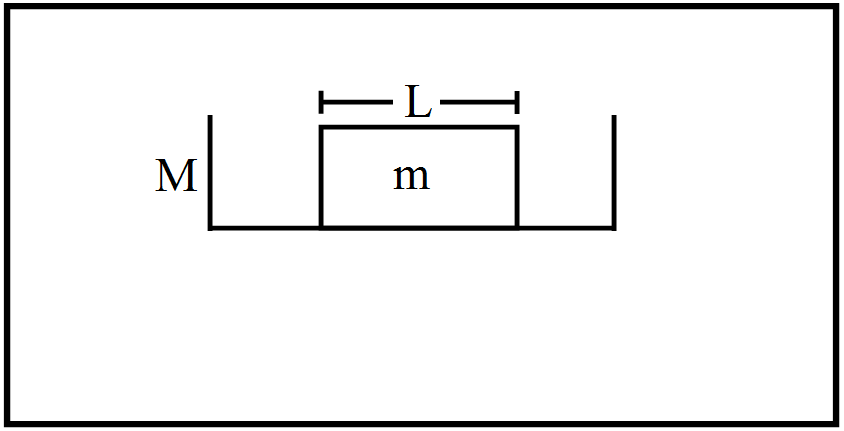
Consider a gravity-free hall in which a tray of mass M, carrying a cubical block of ice of mass m and edge L, is at rest in the middle. If the ice melts, by what distance does the centre of mass of "the tray plus the ice" system descend?
One end of a long string of linear mass density $8.0 \times 10 kg . m ^{-1}$ is connected to an electrically operated tunning fork of frequency 256 Hz . The other end of the string is passed over a stationary pulley and tied to the scale of a balance on which 90 kg weight are hanging. The pulley end absorb all the incoming energy due 90 which the amplitude of the waves reflected from this end is negligible. At $t=0$ the transverse displacement at the left end of the string at $x=0$ is zero $(y=0)$ and it is moving along the positive direction. The amplitude of the wave is 5.0 cm write the transverse displacement $y$ describe this wave on the string as a function of $X$ and $t$.