MCQ
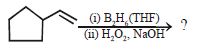
 is converted into  by:
  • $(i)\, CH_3-MgI, H_3O^+$ $(ii)\, H_2SO_4, \Delta ,$ $(iii)\, HBr, R_2O_2$
  • B
    $(i)\, CH_3-MgI, H_3O^+$ $(ii)\, H_2SO_4, \Delta ,$ $(iii)\, HBr$
  • C
    $(i)\, CH_3-MgI, H_3O^+$ $(ii)\,HBr$
  • D
    $(i) \,HBr, R_2O_2$ $(ii)\, CH_3-MgI, H_3O^+$
Answer

Correct option: A.
$(i)\, CH_3-MgI, H_3O^+$ $(ii)\, H_2SO_4, \Delta ,$ $(iii)\, HBr, R_2O_2$
a

Need a full question paper?

Generate a complete, print-ready paper with questions like this in minutes — across 16+ boards, with answer keys.

Start Generating Free

Similar questions

Starting with three different amino acid molecules, how many different tripeptide molecules are formed
Which of the following Compounds has peroxide linkage ?
.......... $atm$ will be the osmotic pressure of $0.2\,M\,K_4[Fe(CN)_6]$ solution at $27\,^oC$ .
${Image}$

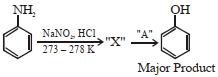
In the above chemical reaction, intermediate $"X"$ and reagent/condition $"A"$ are

Which one of the following phenols does not give colour when condensed with phthalic anhydride in presence of conc. $\mathrm{H}_{2} \mathrm{SO}_{4} ?$
What would be the electrode potential for the given half cell reaction at $pH = 5$ ? ........... $\mathrm{V}$

$2 \mathrm{H}_{2} \mathrm{O} \rightarrow \mathrm{O}_{2}+4 \mathrm{H}^{\oplus}+4 \mathrm{e}^{-} ; \mathrm{E}_{\mathrm{red}}^{0}=1.23 \mathrm{V}$

$(\mathrm{R}=8.314 \;\mathrm{J} \mathrm{mol}^{-1} \mathrm{K}^{-1} ; \text { Temperature }=298 \;\mathrm{K} ;$ oxygen under std. atm. pressure of $1 \;bar$)

The number of $‘H’$ atoms attached to phosphorous atom in hypo-phosphorous acid is
$\,$
At $298 K$, the limiting molar conductivity of a weak monobasic acid is $4 \times 10^2 S cm ^2 mol ^{-1}$. At $298 K$, for an aqueous solution of the acid the degree of dissociation of $\alpha$ and the molar conductivity is $y \times 10^2 S cm ^2 mol ^{-1}$. At $298 K$, upon $20$ times dilution with water, the molar conductivity of the solution becomes $3 y \times 10^2 S cm ^2 mol ^{-1}$.

($1$) The value of $\alpha$ is. . . . . . 

($2$) The value of $y$ is. . . . . . .

Give the answer or quetion ($1$) and ($2$)

On strongly heating $Pb{(N{O_3})_2}$ crystals, the gas formed is