Question
Is it possible to increase the temperature of a gas without adding heat to it? Explain.

Answer

Yes, it is possible to increase the temperature of a gas without adding heat to it, during adiabatic compression the temperature of a gas increases while no heat is given to it. For an adiabatic compression, no heat is given or taken out in adiabatic process. Therefore,$\Delta\text{Q}=0$ According to the first law of thermodynamics, $\Delta\text{Q}=\Delta\text{U}+\Delta\text{W}$ $\Delta\text{U}=-\Delta\text{W}(\Delta\text{Q}=0)$ In compression work is done on the gas, i.e. work done is negativ. Therefore, $\Delta\text{U}=$ positive. Hence, internal energy of the gas increases due to which its temperature increases.

Need a full question paper?

Generate a complete, print-ready paper with questions like this in minutes — across 16+ boards, with answer keys.
Start Generating Free

Similar questions

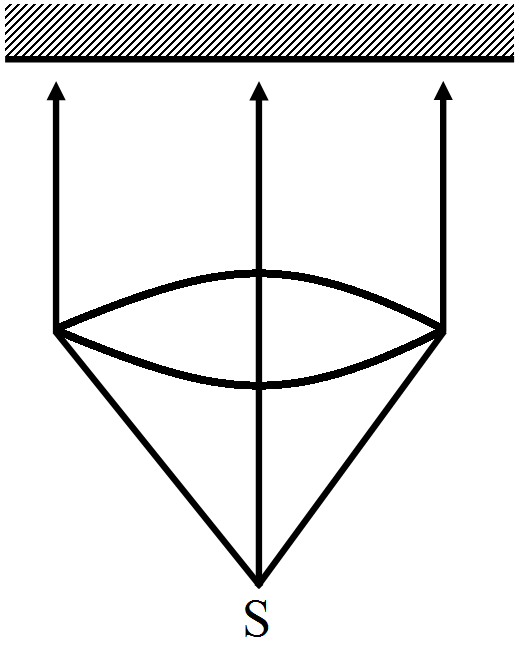
A totally reflecting, small plane mirror placed horizontally faces a parallel beam of light, as shown in the figure. The mass of the mirror is $20g$. Assume that there is no absorption in the lens and that $30\%$ of the light emitted by the source goes through the lens. Find the power of the source needed to support the weight of the mirror. Take $g = 10m/s^2$.
It is a common observation that rain clouds can be at about a kilometre altitude above the ground.
If a rain drop falls from such a height freely under gravity, what will be its speed? Also calculate in km/h. ($g = 10m/s^2$)
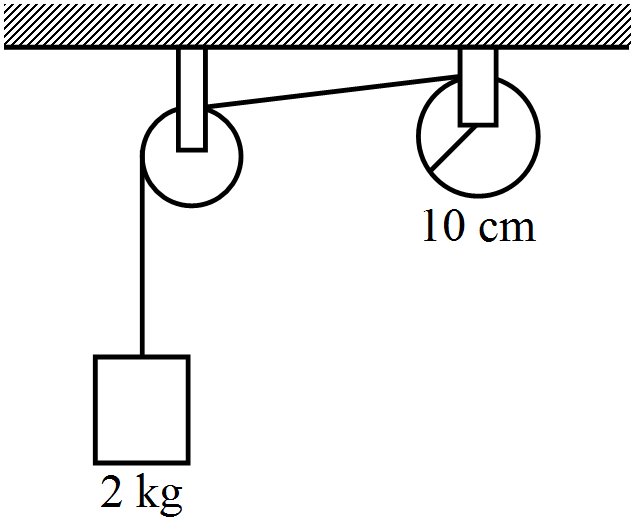
A string is wrapped on a wheel of moment of inertia $0.20kg-m^2$ and radius 10cm and goes through a light pulley to support a block of mass $2.0kg$ as shown in figure. Find the acceleration of the block.
The farthest objects in our Universe discovered by modern astronomers are so distant that light emitted by them takes billions of years to reach the Earth. These objects (known as quasars) have many puzzling features, which have not yet been satisfactorily explained. What is the distance in km of a quasar from which light takes 3.0 billion years to reach us?
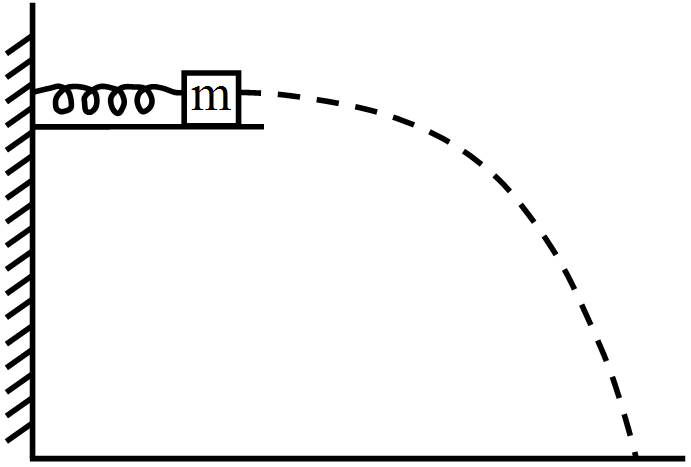
A small block of mass is pressed against a horizontal spring fixed at one end to compress the spring through 5.0cm. When released the block moves horizontally till it leaves the spring. Where will it hit the ground at a distance 2m below the slab? [k = 100N/ m, m = 100g)
The moment of inertia of a uniform rod of mass $0.50kg$ and length $1m$ is $0.10kg-m^2$ about a line perpendicular to the rod. Find the distance of this line from the middle point of the rod.
A particle of 10kg mass is moving in a circle of 4m radius with a constant speed of 5 m/ sec. What is its angular momentum about (i) the centre of circle (ii) a point on the axis of the circle and 3m distant from its centre?
Two waves, travelling in the same direction through the same region, have equal frequencies, wavelengths and amplitudes. If the amplitude of each wave is 4mm and the phase difference between the waves is 90°, what is the resultant amplitude?
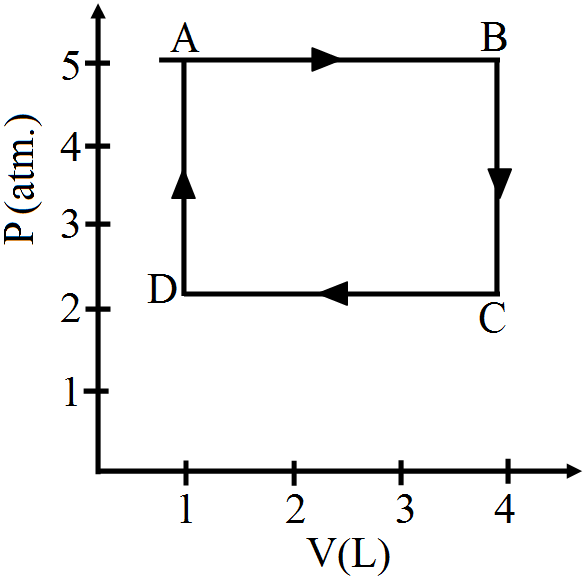
One mole of an ideal gas undergoes a cyclic change ABCD. From the given diagram, calculate the net work done in the process. $1$ atmosphere = $10^\circ dyne\ cm^{-2}$.
There are two displacement vectors, one of magnitude $3m$ and other of magnitude $4m$. How should the two vectors be added so that the magnitude of resultant vector be $(i)\  7m \ (ii)\  1m$ and $(iii)\  5m$?