Question
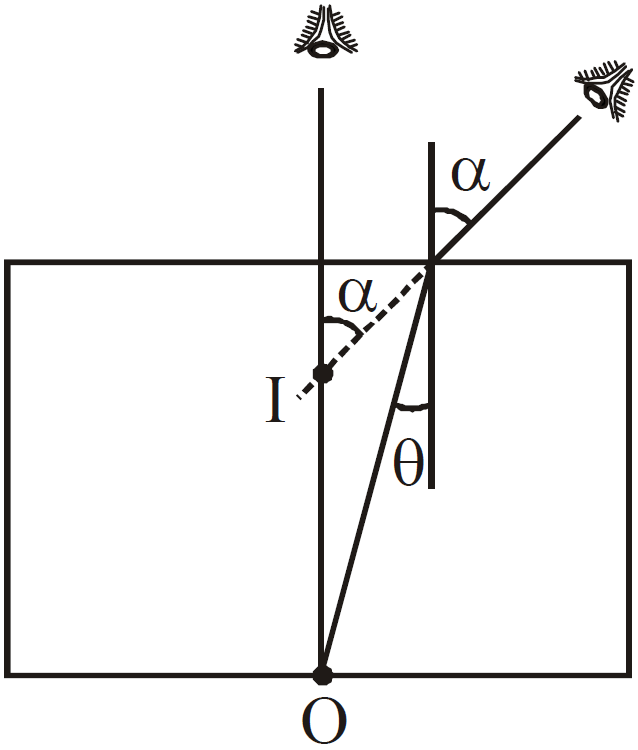
Is the formula "Real depth/ Apparent depth $=\mu$" valid if viewed from a position quite away from the normal?

Answer

No, In the derivation of above formulae $\sin\theta\approx\tan\theta$ this can be done only when angle is small. For eye 1 this approximation can be done but not for eye 2.

Need a full question paper?

Generate a complete, print-ready paper with questions like this in minutes — across 16+ boards, with answer keys.
Start Generating Free

Similar questions

At Deoprayag (Garhwal, UP) river Alaknanda mixes with the river Bhagirathi and becomes river Ganga. Suppose Alaknanda has a width of 12m, Bhagirathi has a width of 8m and Ganga has a width of 16m. Assume that the depth of water is same in the three rivers. Let the average speed of water in Alaknanda be 20km/h and in Bhagirathi be 16km/h. Find the average speed of water in the river Ganga.
What is meant by reflection of light?
The value of electric flux through a closed surface is zero. What does this mean?
Which of the following has the minimum wavelength and which has the maximum wavelength?
Blue light, infrared rays, gamma rays, green light.
The variation of potential difference V with lengthlin case of two potentiometers P and Q is as shown. Which one of these two will you prefer for comparing emfs of two primary cells?
Which waves are used in telecommuni-cation? Write their range.
Kamla peddles a stationary bicycle. The pedals of the bicycle are attached to a 100 turn coil of area $0.10 m ^2$. The coil rotates at half a revolution per second and it is placed in a uniform magnetic field of $0.01 T$ perpendicular to the axis of rotation of the coil. What is the maximum voltage generated in the coil?
What is the direction of the force acting on a charged particle q, moving with a velocity $\overrightarrow{v}$ in a uniform magnetic field $\overrightarrow{B}$?
To measure the magnetic moment of a bar magnet, one may use:
  1. A tangent galvanometer.
  2. A deflection galvanometer if the earth's horizontal field is known.
  3. An oscillation magnetometer if the earth's horizontal field is known.
  4. Both deflection and oscillation magnetometer if the earth's horizontal field is not nown.
When a rod moves at a relativistic speed v, its mass:
  1. Must incrase by a factor of $\curlyvee.$
  2. May remain unchanged.
  3. May increase by a factor other than $\curlyvee.$
  4. May decrease.