Question
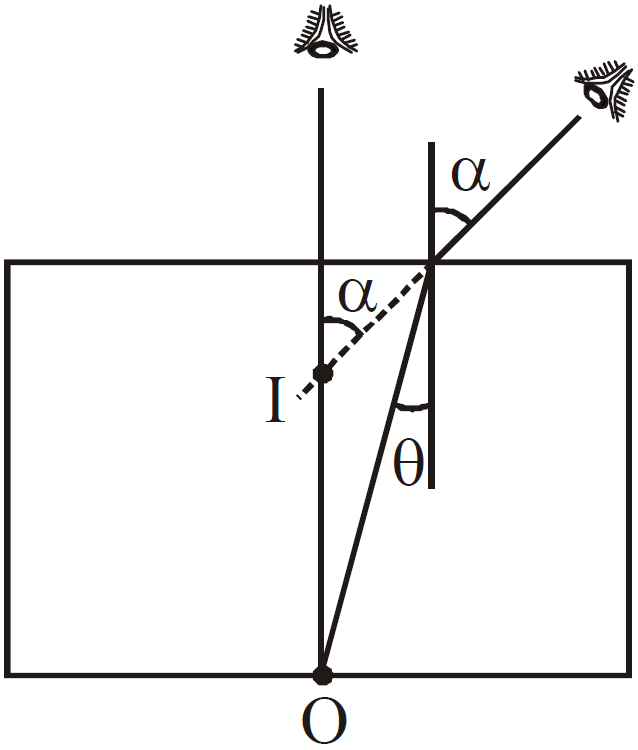
Is the formula "Real depth/ Apparent depth $=\mu$" valid if viewed from a position quite away from the normal?

Answer

No, In the derivation of above formulae $\sin\theta\approx\tan\theta$ this can be done only when angle is small. For eye 1 this approximation can be done but not for eye 2.

Need a full question paper?

Generate a complete, print-ready paper with questions like this in minutes — across 16+ boards, with answer keys.
Start Generating Free

Similar questions

Is it possible for a man sitting in the train to measure induced emf generated in axis of train?
Which of the statements is true for p-type semiconductos.
  1. Electrons are majority carriers and trivalent atoms are the dopants.
  2. Electrons are minority carriers and pentavalent atoms are the dopants.
  3. Holes are minority carriers and pentavalent atoms are the dopants.
  4. Holes are majority carriers and trivalent atoms are the dopants.
The temperature of the atmosphere at a high altitude is around $500^{\circ} \mathrm{C}$. Yet an animal there would freeze to death and not boil. Explain.
Why does the energy of emitted photo-electrons vary even after shining light on the surface of a metal?
Write the reason for this event. Most of the electrons passes through the gold foil without deflected.
What is the meaning of instantaneous power and average power in an ac circuit?
How will the focal length of a convex lens change if red light is used instead of violet light?
If the molecules were not allowed to collide among themselves, would you expect more evaporation or less evaporation?
When an electric dipole is placed in a non- uniform electric field, does it experience a force?
A cube of iron (density $=8000 \mathrm{~kg} \mathrm{~m}^{-3}$, specific heat capacity $=470 \mathrm{~J} \mathrm{~kg}^{-1} \mathrm{~K}^{-1}$ ) is heated to a high temperature and is placed on a large block of ice at $0^{\circ} \mathrm{C}$. The cube melts the ice below it, displaces the water and sinks. In the final equilibrium position, its upper surface just goes inside the ice. Calculate the initial temperature of the cube. Neglect any loss of heat outside the ice and the cube. The density of ice $=900 \mathrm{~kg} \mathrm{~m}^{-3}$ and the latent heat of fusion of ice $=3.36 \times 10^5 \mathrm{~J} \mathrm{~kg}^{-1}$.