Question
Is there any lower limit to the electric force between two particles placed at a separation of 1cm ?

Answer

Yes, there's a lower limit to the electric force between two particles placed at a separation of 1cm, which is equal to the magnitude of force of repulsion between two electrons placed at a separation of 1cm.

Need a full question paper?

Generate a complete, print-ready paper with questions like this in minutes — across 16+ boards, with answer keys.
Start Generating Free

Similar questions

In a solenoid, there are 500 turns/meter and current flowing in it is 5 A . Length of the solenoid is 0.5 m and its radius is 1 cm . Calculate the intensity of magnetic field inside the solenoid.
The refractive index of a material is. What is the angle of refraction if the unpolarised light is incident on it at the polarising angle of the medium?
State the underlying principle of a cyclotron. Write briefly how this machine is used to accelerate charged particles to high energies.
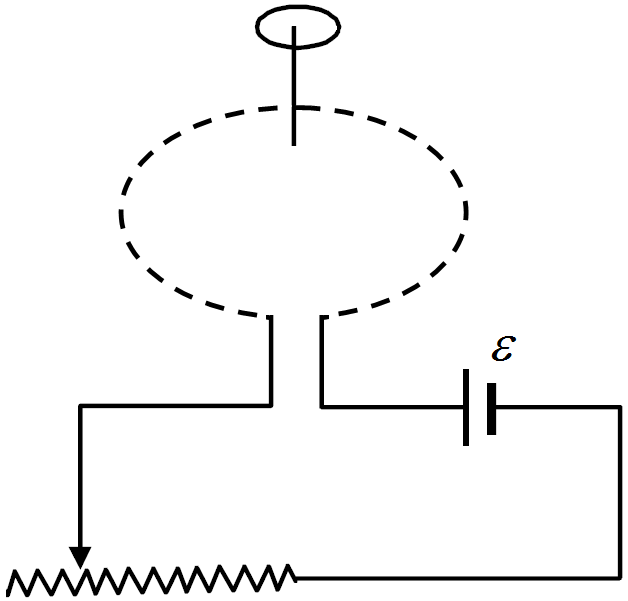
Find the mutual inductance between the circular coil and the loop shown in figure.
The eyepiece of an astronomical telescope has a focal length of $10\ cm.$ The telescope is focused for normal vision of distant objects when the tube length is $1.0m.$ Find the focal length of the objective and the magnifying power of the telescope.
Assume that the magnetic field is uniform in a cubical region and is zero outside. Can you project a charged particle from outside into the field so that the particle describes a complete circle in the field?
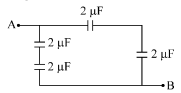
Find the equivalence between A and B in the given circuit diagram.
Image
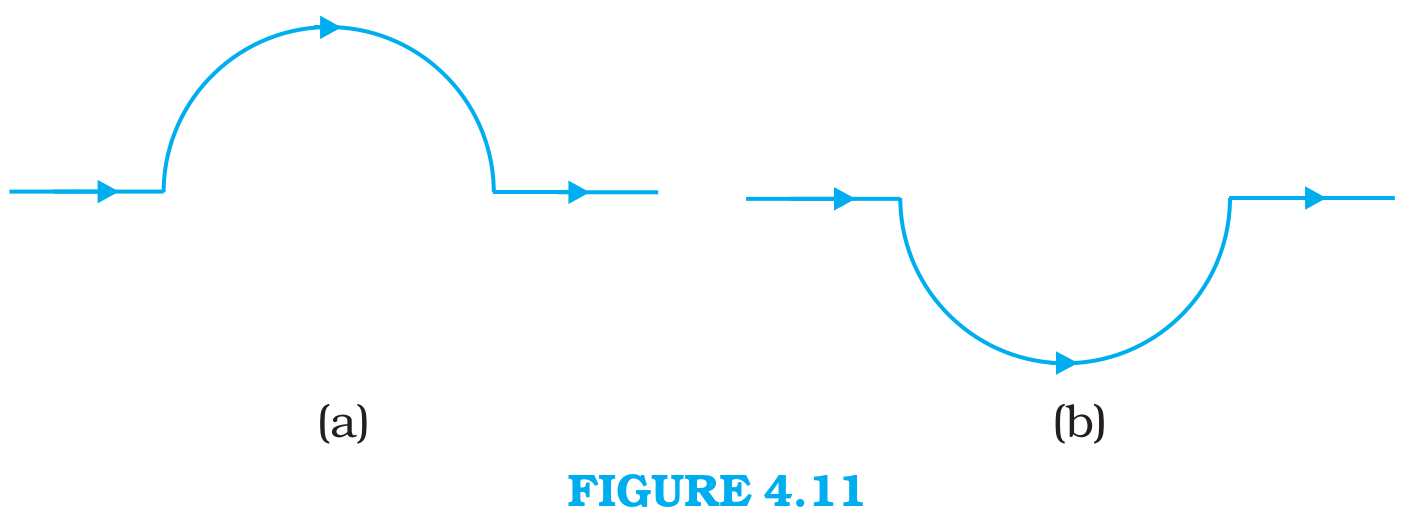
A straight wire carrying a current of $12 A$ is bent into a semi-circular arc of radius $2.0 cm$ as shown in Fig. 4.11 (a). Consider the magnetic field $B$ at the centre of the arc. (a) What is the magnetic field due to the straight segments? (b) In what way the contribution to $B$ from the semicircle differs from that of a circular loop and in what way does it resemble? (c) Would your answer be different if the wire were bent into a semi-circular arc of the same radius but in the opposite way as shown in Fig. 4.11(b)?
Image
The apparent weight of an object increases in an elevator while accelerating upward. A moongphaliwala sells his moongphali using a beam balance in an elevator. Will he gain more if the elevator is accelerating up?
Assume that the magnetic field is uniform in a cubical region and is zero outside. Can you project a charged particle from outside into the field so that the particle describes a complete circle in the field?