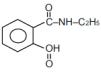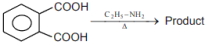
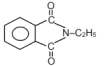
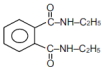
MCQ
is:

  • B

  • C

  • D

Answer

Correct option: A.

a
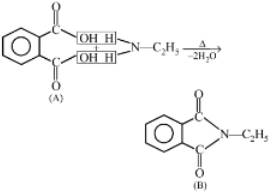
The complete reaction is shown below. (fig)

Need a full question paper?

Generate a complete, print-ready paper with questions like this in minutes — across 16+ boards, with answer keys.

Start Generating Free

Similar questions

Which of the following orders is correct regarding the basic strength of subsituted aniline ?
Which of the following hydroxy ether give $+ve$ test with Tollen's reagent 
Reaction correctly matched with its name ?
What is the atomic number of the element with $M^{2+}$ ion having electronic configuration $\ce{[Ar]3d^8}?$
Electrolytic conduction differs from metallic conduction in that in the case of electrolytic conduction
Which of the following elements shows only one type of oxidation state?
The reaction of $K _3\left[ Fe ( CN )_6\right]$ with freshly prepared $FeSO _4$ solution produces a dark blue precipitate called Turnbull's blue. Reaction of $K _4\left[ Fe ( CN )_6\right]$ with the $FeSO _4$ solution in complete absence of air produces a white precipitate $X$, which turns blue in air. Mixing the $FeSO _4$ solution with $NaNO _3$, followed by a slow addition of concentrated $H _2 SO _4$ through the side of the test tube produces a brown ring.

Precipitate $X$ is

$(A)$ $Fe _4\left[ Fe ( CN )_6\right]_3$

$(B)$ $Fe \left[ Fe ( CN )_6\right]$

$(C)$ $K _2 Fe \left[ Fe ( CN )_6\right]$

$(D)$ $KFe \left[ Fe ( CN )_6\right]$

Among the following, the brown ring is due to the formation of

$(A)$ $\left[ Fe ( NO )_2\left( SO _4\right)_2\right]^{2-}$

$(B)$ $\left[ Fe ( NO )_2\left( H _2 O \right)_4\right]^{3+}$

$(C)$ $\left[ Fe ( NO )_4\left( SO _4\right)_2\right]$

$(D)$ $\left[ Fe ( NO )\left( H _2 O \right)_5\right]^{2+}$

A student has studied the decomposition of a gas $AB _3$ at $25^{\circ} C$. He obtained the following data.

$p ( mm Hg )$ $50$ $100$ $200$ $400$
Relative $t _{1 / 2}( s )$ $4$ $2$ $1$ $0.5$

The order of the reaction is

$Ph - N{H_2}\xrightarrow[{B{r_3}}]{{HN{O_2}}}A\xrightarrow[{Warm}]{{{H_2}O}}B$

$B$ is

Which of the following compounds does not exist