MCQ
Isopropyl alcohol on oxidation forms
- ✓Acetone
- BEther
- CEthylene
- DAcetaldehyde
Generate a complete, print-ready paper with questions like this in minutes — across 16+ boards, with answer keys.
(Image)
$A$ and $B$ respectively are: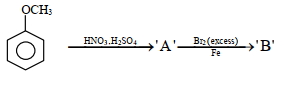
$(A)\, n=4,l=1$ $(B)\, n=4,l=0$
$(C) \,n=3,l=2$ $(D)\, n=3,l=1$
can be placed in order of increasing energy as :
At $ 298 K : \Delta_{ f } H ^{\circ}\left( SnO _2( s )\right)=-581.0 kJ mol ^{-1}, \Delta_{ fH } H ^{\circ}\left( CO _2( g )\right)=-394.0 kJ mol ^{-1}$
$S ^{\circ}\left( SnO _2( s )\right)=56.0 J K ^{-1} mol ^{-1}, S ^{\circ}( Sn ( s ))=52.0 J K ^{-1} mol ^{-1}$
$S ^{\circ}( C ( s ))=6.0 J K ^{-1} mol ^{-1}, S ^{\circ}\left( CO _2( g )\right)=210.0 J K ^{-1} mol ^{-1}$
Assume that the enthalpies and the entropies are temperature independent.