It is easier to start a car engine on a hot day than on a cold day. This is because the internal resistance of the car battery
Easy


Download our appand get started for free
Experience the future of education. Simply download our apps or reach out to us for more information. Let's shape the future of learning together!No signup needed.*
Similar Questions
- 1Two electric bulbs $A$ and $B$ are rated as $60\, W$ and $100\, W$. They are connected in parallel to the same source. Then,View Solution
- 2In $a$ wire of cross-section radius $r$, free electrons travel with drift velocity $v$ when a current $I$ flows through the wire. What is the current in another wire of half the radius and of the same material when the drift velocity is $2v$?View Solution
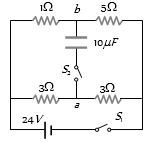
- 3In the circuit shown in figure, switch $S_1$ is initially closed and $S_2$ is open. Find $V_a -V_b$ .............. $V$View Solution
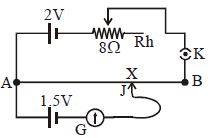
- 4In a potentiometer experiment shown here, for the position $X$ of the jockey $J,$ there occurs a null deflection in the galvanometer. Then the potential difference between points $A$ and $X$ is ................ $V$View Solution
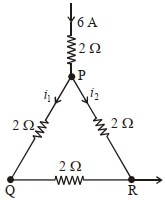
- 5A current of $6\, A$ enters one corner $P$ of an equilateral triangle $PQR$ having $3$ wires of resistance $2 \,\Omega$ each and leaves by the corner $R$. The currents $i_{1}$ in ampere is ........ .View Solution
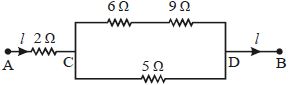
- 6In the circuit shown in figure, the $5\,\Omega $ resistance develops $20.00\,cal/s$ due to the current flowing through it. The heat developed in $2\,\Omega $ resistance (in $cal/s$ ) isView Solution
- 7If two electric bulbs have $40\,W$ and $60\,W$ rating at $220\,V$, then the ratio of their resistances will beView Solution
- 8View SolutionWhich of the following statement is correct
- 9View SolutionThe conductivity of a superconductor is
- 10If two electric bulbs have $40\, W$ and $60\, W$ rating at $220\, V$, then the ratio of their resistances will beView Solution