Question
It is found experimentally that $13.6 eV$ energy is required to separate a hydrogen atom into a proton and an electron. Compute the orbital radius and the velocity of the electron in a hydrogen atom.

Answer

Total energy of the electron in hydrogen atom is $-13.6 eV =$ $-13.6 \times 1.6 \times 10^{-19} J =-2.2 \times 10^{-18} J$. Thus from Eq. (12.4), we have
$
E=-\frac{e^2}{8 \pi \varepsilon_0 r}=-2.2 \times 10^{-18} J
$
This gives the orbital radius
$
\begin{aligned}
r & =-\frac{e^2}{8 \pi \varepsilon_0 E}=-\frac{\left(9 \times 10^9 N m ^2 / C ^2\right)\left(1.6 \times 10^{-19} C \right)^2}{(2)\left(-2.2 \times 10^{-18} J \right)} \\
& =5.3 \times 10^{-11} m .
\end{aligned}
$
The velocity of the revolving electron can be computed from Eq. (12.3) with $m=9.1 \times 10^{-31} kg$,
$
v=\frac{e}{\sqrt{4 \pi \varepsilon_0 m r}}=2.2 \times 10^6 m / s
$

Need a full question paper?

Generate a complete, print-ready paper with questions like this in minutes — across 16+ boards, with answer keys.
Start Generating Free

Similar questions

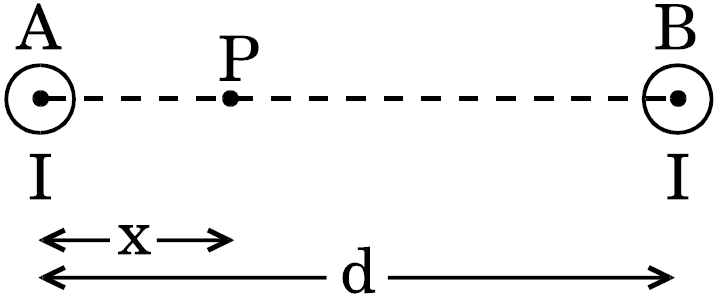
Two long straight parallel wires A and B separated by a distance d, carry equal current I flowing in same direction as shown in the figure.

  1. Find the magnetic field at a point P situated between them at a distance x from one wire.
  2. Show graphically the variation of the magnetic field with distance x for 0 < x < d.
In a series LCR circuit, the voltage across an inductor, a capacitor and a resistor are 30V, 30V and 60V respectively. What is the phase difference between the applied voltage and current in the circuit?
Define the magnification of a spherical mirror.
Explain the Rutherford atomic model and its limitations.
The coil of a moving-coil galvanometer keeps on oscillating for a long time if it is deflected and released. If the ends of the coil are connected together, the oscillation stops at once. Explain
A point charge produces an electric field of magnitude 5.0NC-1 at a distance of 40cm from it. What is the magnitude of the charge?
Radioactive 131I has a half-life of 8.0 days. A sample containing 131I has activity $20\mu\text{Ci}$ at t = 0.
  1. What is its activity at t = 4 days?
  2. What is its decay constant at t = 4.0 days?
(a) When monochromatic light is incident on a surface separating two media, the reflected and refracted light both have the same frequency as the incident frequency. Explain why?
(b) When light travels from a rarer to a denser medium, the speed decreases. Does the reduction in speed imply a reduction in the energy carried by the light wave?
(c) In the wave picture of light, intensity of light is determined by the square of the amplitude of the wave. What determines the intensity of light in the photon picture of light.
Find the electric potential energy of a system made up of three point charges.
The masses of 11C and 11B are respectively 11.0114u and 11.0093u. Find the maximum energy a positron can have in the $\beta^+$-decay of 11C to 11B.