Question
It is found that $|\text{A}+\text{B}|=|\text{A}|.$ This necessarily implies,
  1. $\text{B}=0$
  2. A, B are antiparallel.
  3. A, B are perpendicular.
  4. $\text{A.B}≤0$

Answer

  1. $(\vec{\text{A}}\times\vec{\text{B}})\times\vec{\text{C}}$ is not zero unless $\vec{\text{B}},\ \vec{\text{C}}$ are parallel.

Explanation:

$|\vec{\text{A}}+\vec{\text{B}}|=|\vec{\text{A}}|$

Applying dot product,

$|\vec{\text{A}}+\vec{\text{B}}|.|\vec{\text{A}}+\vec{\text{B}}|=|\vec{\text{A}}|.|\vec{\text{A}}|$

$\Rightarrow\ |\vec{\text{A}}|^2+2\vec{\text{A}}.\vec{\text{B}}+|\vec{\text{B}}|^2=|\text{A}|^2$

$\Rightarrow\ |\vec{\text{B}}|^2=-2\vec{\text{A}}.\vec{\text{B}}$

$\Rightarrow\ |\vec{\text{B}}|=0$

Therefore, option (a) is correct.

Need a full question paper?

Generate a complete, print-ready paper with questions like this in minutes — across 16+ boards, with answer keys.
Start Generating Free

Similar questions

A particle is executing simple harmonic motion with an amplitude of $0.02$ metre and frequency $50\, Hz$. The maximum acceleration of the particle is
If M is the mass of the earth and R its radius, the ratio of the gravitational acceleration and the gravitational constant is:
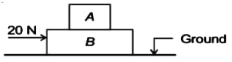
Blocks shown in figure moves with constant velocity $10 \,m / s$ towards right. All surfaces in contact are rough. The friction force applied by $B$ on $A$ is ...........$N$
A closed organ pipe and an open organ pipe are tuned to the same fundamental frequency. What is the ratio of lengths
The dimensions of impulse are equal to that of
A light rod of length $200\,cm$ is suspended from the ceiling horizontally by means of two vertical wires of equal length tied to its ends. One of the wires is made of steel and is of cross-section $0.1\,cm^2$ and the other of brass of cross-section $0.2\,cm^2$ . Along the rod at which distance a weight may be hung to produce equal stresses in both the wires?
A particle starts moving from rest in a straight line with constant acceleration. After time $t_0$, acceleration changes its sign (just opposite to the initial direction), remaining the same in magnitude. Determine the time from the beginning of motion in which the particle returns to the initial position.
A cricketer can throw a ball to a maximum horizontal distance of $100\, m$. The speed with which he throws the ball is   ......... $ms^{-1}$ (to the nearest integer)
At a certain temperature for given wave length, the ratio of emissive power of a body to emissive power of black body in same circumstances is known as
A particle executing S.H.M. has a maximum speed of 30cm/ s and a maximum acceleration of 60cm/ s2.The period of oscillation is: