MCQ
It is found that $|\text{A}+\text{B}|=|\text{A}|.$ This necessarily implies,
  • A
    $\text{B}=0$
  • B
    A, B are antiparallel.
  • C
    A, B are perpendicular.
  • D
    $\text{A.B}≤0$

Answer

  1. $(\vec{\text{A}}\times\vec{\text{B}})\times\vec{\text{C}}$ is not zero unless $\vec{\text{B}},\ \vec{\text{C}}$ are parallel.

Explanation:

$|\vec{\text{A}}+\vec{\text{B}}|=|\vec{\text{A}}|$

Applying dot product,

$|\vec{\text{A}}+\vec{\text{B}}|.|\vec{\text{A}}+\vec{\text{B}}|=|\vec{\text{A}}|.|\vec{\text{A}}|$

$\Rightarrow\ |\vec{\text{A}}|^2+2\vec{\text{A}}.\vec{\text{B}}+|\vec{\text{B}}|^2=|\text{A}|^2$

$\Rightarrow\ |\vec{\text{B}}|^2=-2\vec{\text{A}}.\vec{\text{B}}$

$\Rightarrow\ |\vec{\text{B}}|=0$

Therefore, option (a) is correct.

Need a full question paper?

Generate a complete, print-ready paper with questions like this in minutes — across 16+ boards, with answer keys.
Start Generating Free

Similar questions

A simple harmonic wave having an amplitude a and time period $T$ is represented by the equation $y = 5\sin \pi (t + 4)m.$ Then the value of amplitude $(a)$ in $(m)$ and time period $(T) $ in second are
If mass of $He$ atom is $4$ times that of hydrogen atom then mean velocity of $He$ is
A copper wire $(Y = 1 \times 10^{11}\, N/m^2)$ of length $6\, m$ and a steel wire $(Y = 2 \times 10^{11}\, N/m^2)$ of length $4\, m$ each of cross section $10^{-5}\, m^2$ are fastened end to end and stretched by a tension of $100\, N$. The elongation produced in the copper wire is ......... $mm$
A cylindrical wire of radius $1\,\, mm$, length $1 m$, Young’s modulus $= 2 × 10^{11} N/m^2$, poisson’s ratio $\mu = \pi /10$ is stretched by a force of $100 N$. Its radius will become
The pressure of water in a water pipe when tap is opened and closed is respectively $3 \times 10^5\,N/m^2$ and $3.5 \times 10^5\,N/m^2$ . With open tap, the velocity of water flowing is ........... $m/s$
Two spherical bodies $\mathrm{A}$ (radius $6 \mathrm{~cm}$ ) and $\mathrm{B}$ (radius $18 \mathrm{~cm}$ ) are at temperature $\mathrm{T}_1$ and $\mathrm{T}_2$, respectively. The maximum intensity in the emission spectrum of $\mathrm{A}$ is at $500 \mathrm{~nm}$ and in that of $\mathrm{B}$ is at $1500 \mathrm{~nm}$. Considering them to be black bodies, what will be the ratio of the rate of total energy radiated by $A$ to that of $B$ ?
An object of mass $5\, kg$ is attached to the hook of a spring balance and the balance is suspended vertically from the roof of a lift. The reading of the spring balance when the lift is going up with an acceleration of $0.25\, ms^{-2}$ is  ......... $N$ $(g = 10\, m/s^2)$
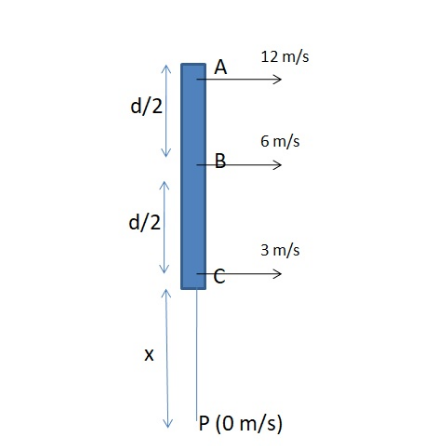
In the image shown. AC is a rigid rod of length 12cms rotating about point P, whose velocities are shown in the figure. Find the distance PC = x

A car travels $6\, km$ towards north at an angle of $45^o$ to the east and then travels distance of $4\, km$ towards north at an angle $135^o$ to east. How far is the point from the starting point? What angle does the straight line joining its initial and final position makes with the east?
A uniform rope having some mass hanges vertically from a rigid support. A transverse wave pulse is produced at the lower end. The speed $(v)$ of the wave pulse varies with height $(h)$ from the lower end as: