Question
It is found that yellow light does not eject photoelectrons from a metal. Is it advisable to try with orange light? With green light?

Answer

Photoelectrons are emitted from a metal's surface if the frequency of incident radiation is more than the threshold frequency of the given metal surface. As yellow light does not eject photoelectrons from a metal it means that the threshold frequency of the metal is more than the frequency of yellow light. Since the frequency of orange light is less than the frequency of yellow light, therefore it will not be able to eject photoelectrons from the metal's surface. The frequency of green light is more than the frequency of yellow light. Hence, when it is incident on the metal surface, it will eject electrons from the metal.
Need a full question paper?

Generate a complete, print-ready paper with questions like this in minutes — across 16+ boards, with answer keys.

Start Generating Free

Similar questions

Deuteron is a bound state of a neutron and a proton with a binding energy B = 2.2MeV. A γ-ray of energy E is aimed at a deuteron nucleus to try to break it into a (neutron + proton) such that the n and p move in the direction of the incident γ-ray. If E = B, show that this cannot happen. Hence calculate how much bigger than B must E be for such a process to happen.
A converging lens of focal length 15cm and a converging mirror of focal length 10cm are placed 50cm apart with common principal axis. A point source is placed in between the lens and the mirror at a distance of 40cm from the lens. Find the locations of the two images formed.
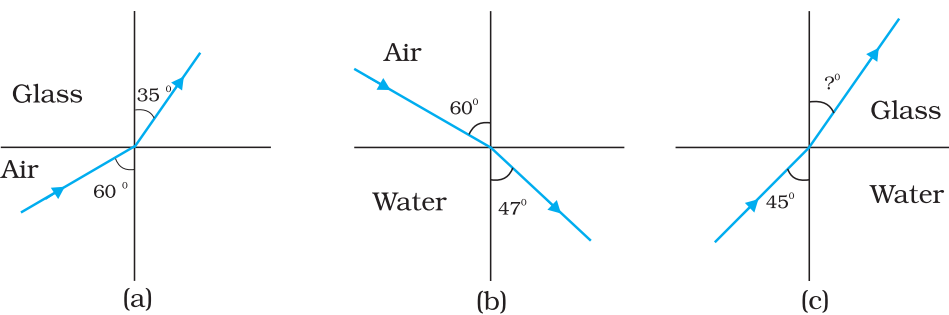
(a) and (b) show refraction of a ray in air incident at 60° with the normal to a glass-air and water-air interface, respectively. Predict the angle of refraction in glass when the angle of incidence in water is 45º with the normal to a water - glass interface.
Using Huygens' principle, draw a diagram to show propagation of a wavefront originating from a monochromatic point source. Explain briefly.
A $100\mu\text{F}$ capacitor is joined to a 24V battery through a $1.0\text{M}\Omega$ resistor. Plot qualitative graphs (a) between current and time for the first 10 minutes and (b) between charge and time for the same period.
A car travelling at 60km/h overtakes another car travelling at 42km/h. Assuming each car to be 5.0m long, find the time taken during the overtake and the total road distance used for the overtake.
Propound Coulomb's law. On the basis of this rule, write the definition of Coulomb, the unit of charge. If there is a medium between the charges then how will the electric force change with the medium?
Find the magnitude of the electric field at a point 4cm away from a line charge of density $2 \times 10^{-6}Cm^{-1}.$
A tightly-wound solenoid of radius a and length l has n turns per unit length. It carries an electric current i. Consider a length dx of the solenoid at a distance x from one end. This contains n(dx) turns and may be approximated as a circular current in (dx).
  1. Write the magnetic field at the centre of the solenoid due to this circular current. Integrate this expression under proper limits to find the magnetic field at the centre of the solenoid.
  2. Verify that if a >> l, the field tends to $\text{B}=\frac{\mu_0\text{nil}}{2\text{a}}.$ Interpret these results.
Two current-carrying wires may attract each other. In absence of other forces, the wires will move towards each other increasing the kinetic energy. Does it contradict the fact that the magnetic force cannot do any work and hence cannot increase the kinetic energy?