Question
It is heard sometime that mercury is used in defining the temperature scale because it expands uniformly with temperature. If the temperature scale is not yet defined, is it logical to say that a substance expands uniformly with temperature?
Answer

It is not illogical to say that mercury expands uniformly before temperature scale was defined. It's uniform expansion can be studied by comparing the expansion of mercury with expansion of other substances (like alcohol water etc).

Need a full question paper?

Generate a complete, print-ready paper with questions like this in minutes — across 16+ boards, with answer keys.

Start Generating Free

Similar questions

Write down the conditions for constructive and destructive interference in terms of path difference.
Two heating coils, one of fine wire and other of thick wire, made of the same material and of the same length are connected one by one to a source of electricity. Which coil will produce heat at a greater rate?
A long straight wire carrying a current of $30$ A is placed in an external uniform magnetic field of $4.0 \times 10^{-4} T$ parallel to the current. Find the magnitude of the resultant magnetic field at a point $2.0 \ cm$ away from the wire.
As the wavelength is increased from violet to red, the luminosity:
  1. Continuously increases.
  2. Continuously decreases.
  3. Increases then decreases.
  4. Decreases then increases.
Two protons and two electrons are hanging freely at equal distances. Compare the repulsion force between proton and electron.
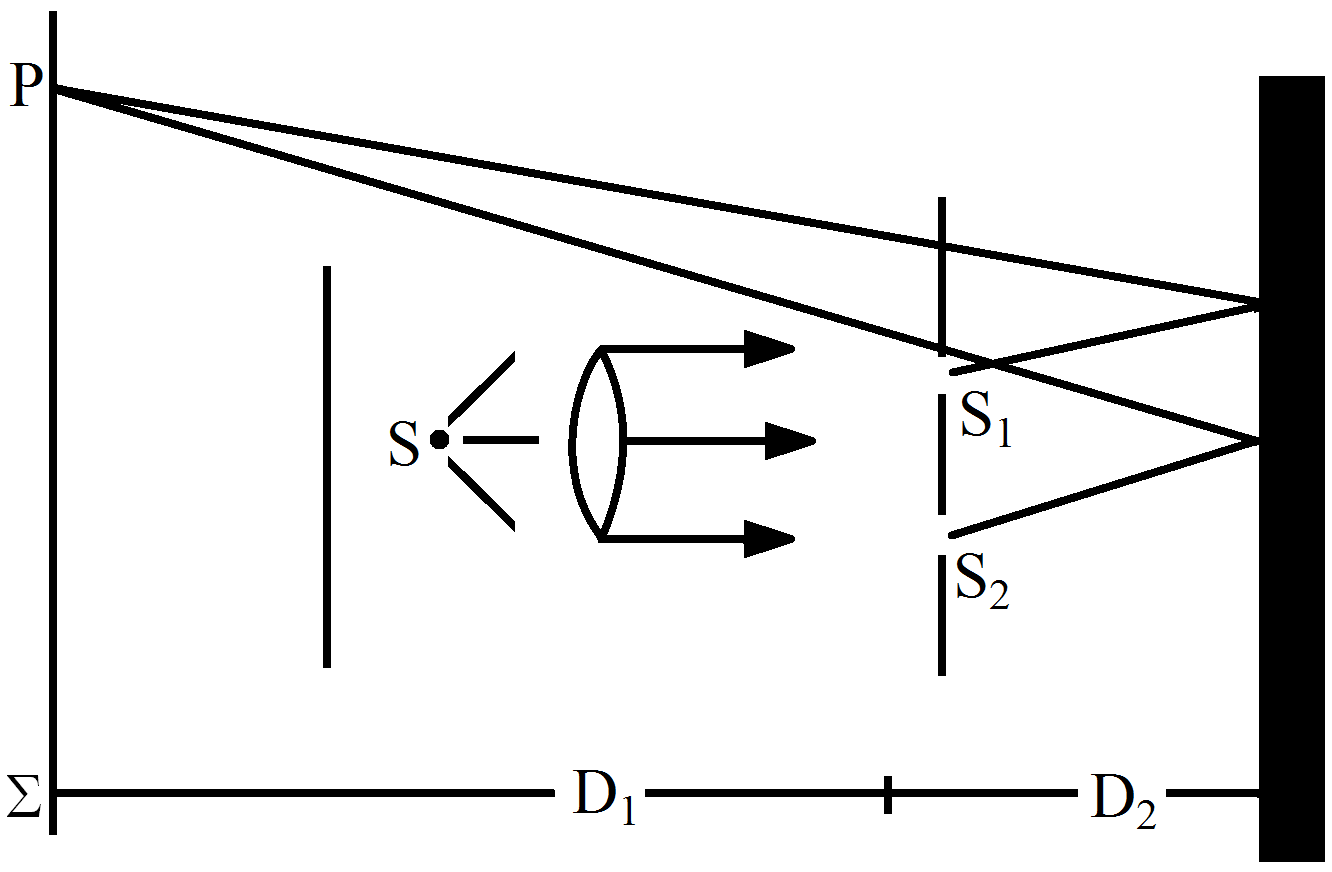
A double slit $S_1-S_2$ is illuminated by a coherent light of wavelength $\lambda$. The slits are separated by a distance $d$. A plane mirror is placed in front of the double slit at a distance $D_1$ from it and a screen $\sum$ is placed behind the double slit at a distance $D_2$ from it (figure $17-E_2$ ). The screen E receives only the light reflected by the mirror. Find the fringe-width of the interference pattern on the screen.
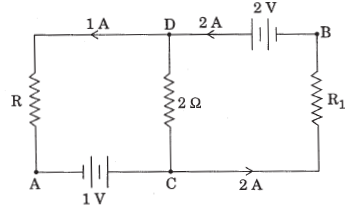
In the given circuit, assuming point A to be at zero potential, use Kirchhoff's rules to determine the potential at point B.
An equilateral glass prism has a refractive index 1.6 in air. Calculate the angle of minimum deviation of the prism, when kept in a medium of refractive index $\frac{4\sqrt2}{5}.$
Define the international definition of ampere.
Two wires A and B are made up of same material. Their areas of cross-section is same and ratio of their lengths is $2: 1$. If same potential difference is applied across the ends of lengths of each wire, then what will be the ratio of current flowing in the two wires?