Question
It is known that, if the interest is compounded continuously, the principal changes at the rate equal to the product of the rate of bank interest per annum and the principal. Let $P$ denotes the principal at any time $t$ and rate of interest be $r\%$ per annum.

Based on the above information, answer the following question.
  1. Find the value of $\frac{\text{dP}}{\text{dt}}.$
  1. $\frac{\text{Pr}}{1000}$
  2. $\frac{\text{Pr}}{100}$
  3. $\frac{\text{Pr}}{10}$
  4. $\text{Pr}$
  1. If $P_0$ be the initial principal, then find the solution of differential equation formed in given situation.
  1. $\log\Big(\frac{\text{P}}{\text{P}_0}\Big)=\frac{\text{rt}}{100}$
  2. $\log\Big(\frac{\text{P}}{\text{P}_0}\Big)=\frac{\text{rt}}{10}$
  3. $\log\Big(\frac{\text{P}}{\text{P}_0}\Big)=\text{rt}$
  4. $\log\Big(\frac{\text{P}}{\text{P}_0}\Big)=100\text{rt}$
  1. If the interest is compounded continuously at $5\%$ per annum, in how many years will $₹\ 100$ double itself?
  1. $12.728$ years
  2. $14.789$ years
  3. $13.862$ years
  4. $15.872$ years
  1. At what interest rate will $₹\ 100$ double itself in $10$ years? $(\log_\text{e}2 = 0.6931 ).$
  1. $9.66\%$
  2. $8.239\%$
  3. $7.341\%$
  4. $6.931\%$
  1. How much will $₹\ 1000$ be worth at $5\%$ interest after $10$ years? $(e^{0.5} = 1.648)$.
  1. $₹\ 1648$
  2. $₹\ 1500$
  3. $₹\ 1664$
  4. $₹\ 1572$

Answer

  1. $(b) \frac{\text{Pr}}{100}$
Here, $P$ denotes the principal at any time $t$ and the rate of interest be $r\%$ per annum compounded continuously, then according to the law given in the problem, we get
$\frac{\text{dP}}{\text{dt}}=\frac{\text{Pr}}{100}$
  1. $(a) \log\Big(\frac{\text{P}}{\text{P}_0}\Big)=\frac{\text{rt}}{100}$
We have, $\frac{\text{dP}}{\text{dt}}=\frac{\text{Pr}}{100}$
$\Rightarrow\frac{\text{dP}}{\text{P}}=\frac{\text{r}}{100}\text{dt}$
$\Rightarrow\int\frac{\text{1}}{\text{P}}\text{dP}=\frac{\text{r}}{100}\int\text{dt}$
$\Rightarrow\log\text{P}=\frac{\text{rt}}{100}+\text{C}...\text{(i)}$
$\text{At t}=0,\ \ \text{P}=\text{P}_0.$
$\therefore\ \ \text{C}=\log\text{P}_0$
So, $\log\text{P}=\frac{\text{rt}}{100}+\log\text{p}_0$
$\Rightarrow\log\Big(\frac{\text{P}}{\text{P}_0}\Big)=\frac{\text{rt}}{100}...\text{(ii)}$
  1. $(c) 13.862$ years
We have, $r = 5, P_{0 }= ₹\ 100$ and $P = ₹\ 200 = 2P_0$ Substituting these values in $(2),$ we get
$\log2=\frac{5}{100}\text{t}$
$\Rightarrow\text{t}=20\log_\text{e}$
$2 = 20 \times 0.6931\ \text{years} = 13.862\ \text{years}$
  1. $(d) 6.931\%$
We have,
$P_0 = ₹\ 100, P = ₹\ 200 = 2P_{0 }$ and $t = 10$ years Substituting these values in $(2),$ we get
$\log2\frac{10\text{r}}{100}\Rightarrow\text{r}=10\log2=10\times0.6931=6.931$
  1. $(a)\ ₹ 1648$
We have $P_0 = ₹\ 1000, r = 5$ and $t = 10$ Substituting these values in $(2),$ we get
$\log\Big(\frac{\text{P}}{1000}\Big)=\frac{5\times10}{100}=\frac{1}{2}=0.5$
$\Rightarrow\frac{\text{P}}{1000}=\text{e}^{0.5}$
$\Rightarrow\text{ P} = 1000 × 1.648 = ₹ \ 1648$

Need a full question paper?

Generate a complete, print-ready paper with questions like this in minutes — across 16+ boards, with answer keys.

Start Generating Free

Similar questions

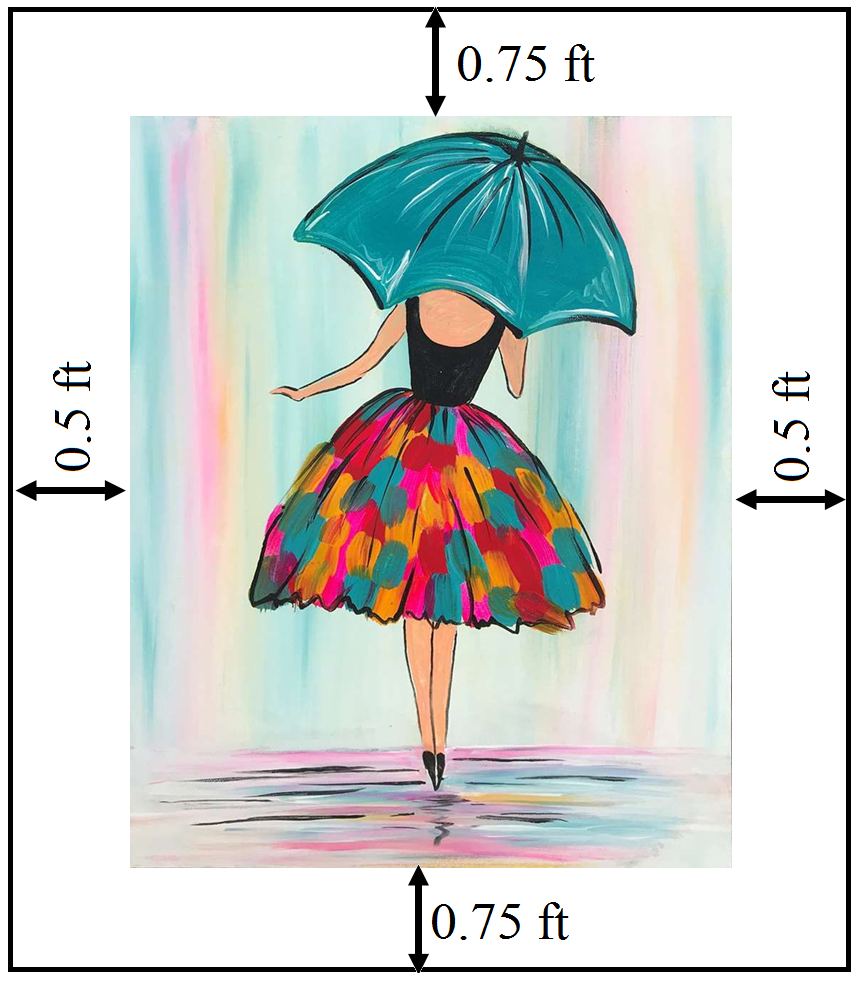
Kyra has a rectangular painting canvas having a total area of $24\ ft^2$ which includes a border of $0.5\ ft.$ on the left right and a border of $0.75\ ft.$ on the bottom, top inside it.

Based on the above information, answer the following questions.
  1. If Kyra wants to paint in the maximum area, then she needs to maximize.
  1. Area of outer rectangle.
  2. Area of inner rectangle.
  3. Area of top border.
  4. None of these.
  1. If $x$ is the length of the outer rectangle, then area of inner rectangle in terms of $x$ is.
  1. $(\text{x}+3)\Big(\frac{24}{\text{x}}-2\Big)$
  2. $(\text{x}-1)\Big(\frac{24}{\text{x}}+1.5\Big)$
  3. $(\text{x}-1)\Big(\frac{24}{\text{x}}-1.5\Big)$
  4. $(\text{x}-1)\Big(\frac{24}{\text{x}}\Big)$
  1. Find the range of $x.$
  1. $(1, \infty)$
  2. $(1, 16)$
  3. $(-\infty, 16)$
  4. $(-1, 16)$
  1. If area of inner rectangle is maximum, then $x$ is equal to.
  1. $2\ ft.$
  2. $3\ ft.$
  3. $4\ ft.$
  4. $5\ ft.$
  1. If area of inner rectangle is maximum, then length and breadth of this rectangle are respectively.
  1. $3\ ft, 4.5\ ft.$
  2. $4.5\ ft, 5\ ft.$
  3. $1\ ft, 2\ ft.$
  4. $2\ ft, 4\ ft.$
Arka bought two cages of birds: Cage $-I $ contains $5$ parrots and $1$ owl and Cage $-II$ contains $6$ parrots. One day Arka forgot to lock both cages and two birds flew from Cage $-I$ to Cage $-II$ $($simultaneously$)$. Then two birds flew back from cage $-II$ to cage $-I \ ($simultaneously$)$.
Assume that all the birds have equal chances of flying.
On the basis of the above information, answer the following questions: $-$
$(i)$ When two birds flew from Cage $-I$ to Cage $-II$ and two birds flew back from Cage $-II$  to Cage $-I$ then find the probability that the owl is still in Cage $-I.$
$(ii)$ When two birds flew from Cage $-I$ to Cage $-II$ and two birds flew back from Cage $-II$ to Cage-I, the owl is still seen in Cage $-I,$ what is the probability that one parrot and the owl flew from Cage $-I$ to Cage $-II$?
Two farmers Shyam and Balwan Singh cultivate only three varieties of pulses namely Urad, Masoor and Mung. The sale (in ₹) of these varieties of pulses by both the farmers in the month of September and October are given by the following matrices A and B.

September sales (in ₹)
$\begin{matrix}\ \ \ \ \ \ \ \ \ \ \text{Urad}&\text{Masoor}&\text{Mung}\end{matrix}\\\text{A}=\begin{bmatrix}10000&20000&30000\\50000&30000&10000\end{bmatrix}\begin{matrix}\text{Shayam}\\\text{Balwan singh}\end{matrix}$
October sales (in ₹)
$\begin{matrix}\ \ \ \ \ \ \ \ \ \ \text{Urad}&\text{Masoor}&\text{Mung}\end{matrix}\\\text{B}=\begin{bmatrix}10000&20000&30000\\50000&30000&10000\end{bmatrix}\begin{matrix}\text{Shayam}\\\text{Balwan singh}\end{matrix}$
Using algebra of matrices, answer the following questions.
  1. The combined sales of Masoor in September and October, for farmer Balwan Singh, is:
  1. ₹ 80000
  2. ₹ 90000
  3. ₹ 40000
  4. ₹ 135000
  1. The combined sales of Urad in September and October, for farmer Shyam is:
  1. ₹ 20000
  2. ₹ 30000
  3. ₹ 36000
  4. ₹ 15000
  1. Find the decrease in sales of Mung from September to October, for the farmer Shyam.
  1. ₹ 24000
  2. ₹ 10000
  3. ₹ 30000
  4. No change
  1. If both farmers receive 2% profit on gross sales, compute the profit for each farmer and for each variety sold in October.
  1. $\begin{matrix} \ \text{Urad}&\text{Masoor}&\text{Mung}\end{matrix}\\\begin{bmatrix}100&\ \ \ \ \ \ 200&\ \ \ \ \ 220\\400&\ \ \ \ \ \ 300&\ \ \ \ \ 200\end{bmatrix}\begin{matrix}\text{Shayam}\\\text{Balwan singh}\end{matrix}$
  2. $\begin{matrix} \ \text{Urad}&\text{Masoor}&\text{Mung}\end{matrix}\\\begin{bmatrix}100&\ \ \ \ \ \ 200&\ \ \ \ \ 120\\400&\ \ \ \ \ \ 200&\ \ \ \ \ 200\end{bmatrix}\begin{matrix}\text{Shayam}\\\text{Balwan singh}\end{matrix}$
  3. $\begin{matrix} \ \text{Urad}&\text{Masoor}&\text{Mung}\end{matrix}\\\begin{bmatrix}150&\ \ \ \ \ \ 200&\ \ \ \ \ 220\\400&\ \ \ \ \ \ 200&\ \ \ \ \ 280\end{bmatrix}\begin{matrix}\text{Shayam}\\\text{Balwan singh}\end{matrix}$
  4. $\begin{matrix} \ \text{Urad}&\text{Masoor}&\text{Mung}\end{matrix}\\\begin{bmatrix}100&\ \ \ \ \ \ 200&\ \ \ \ \ 120\\250&\ \ \ \ \ \ 200&\ \ \ \ \ 220\end{bmatrix}\begin{matrix}\text{Shayam}\\\text{Balwan singh}\end{matrix}$
  1. Which variety of pulse has the highest selling value in the month of September for the farmer Balwan Singh?
  1. Urad
  2. Masoor
  3. Mung
  4. All of these have the same price
In a family there are four children. All of them have to work in their family business to earn their livelihood at the age of 18. Based on the above information, answer the following questions.
  1. Probability that all children are girls, if it is given that elder child is a boy, is:
  1. $\frac{3}{8}$
  2. $\frac{1}{8}$
  3. $\frac{5}{8}$
  4. None of these.
  1. Probability that all children are boys, if two elder children are boys, is:
  1. $\frac{1}{4}$
  2. $\frac{3}{4}$
  3. $\frac{1}{2}$
  4. None of these.
  1. Find the probability that two middle children are boys, if it is given that eldest child is a girl.
  1. $0$
  2. $\frac{3}{4}$
  3. $\frac{1}{4}$
  4. None of these.
  1. Find the probability that all children are boys, if it is given that at most one of the children is a girl.
  1. $0$
  2. $\frac{1}{5}$
  3. $\frac{2}{5}$
  4. $\frac{4}{5}$
  1. Find the probability that all children are boys, if it is given that at least three of the children are boys.
  1. $\frac{1}{5}$
  2. $\frac{2}{5}$
  3. $\frac{3}{5}$
  4. $\frac{4}{5}$
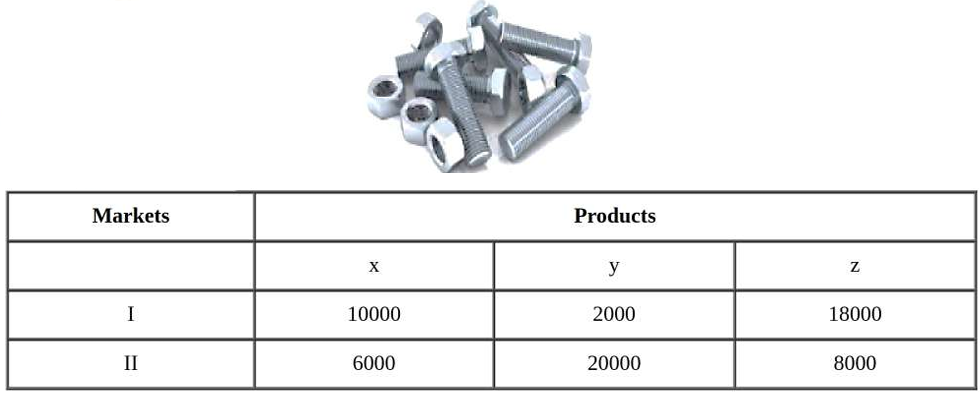
The nut and bolt manufacturing business has gained popularity due to the rapid Industrialization and introduction of the Capital-Intensive Techniques in the Industries that are used as the Industrial fasteners to connect various machines and structures. Mr. Suresh is in Manufacturing business of Nuts and bolts. He produces three types of bolts, $\mathrm{x}, \mathrm{y}$, and $\mathrm{z}$ which he sells in two markets. Annual sales (in ₹) indicated below:

Image

(i) If unit sales prices of $x, y$ and $z$ are $₹ 2.50$, ₹ 1.50 and $₹ 1.00$ respectively, then find the total revenue collected from Market-I \&II.

(ii) If the unit costs of the above three commodities are ₹2.00, ₹ 1.00 and 50 paise respectively, then find the cost price in Market I and Market II.

(iii) If the unit costs of the above three commodities are ₹2.00, ₹1.00 and 50 paise respectively, then find gross profit from both the markets.

OR

If matrix $\mathrm{A}=\left[a_{i j}\right]_{2 \times 2}$ where $\mathrm{a}_{\mathrm{ij}}=1$, if $\mathrm{i} \neq \mathrm{j}$ and $\mathrm{a}_{\mathrm{ij}}=0$, if $\mathrm{i}=\mathrm{j}$ then find $\mathrm{A}^2$.

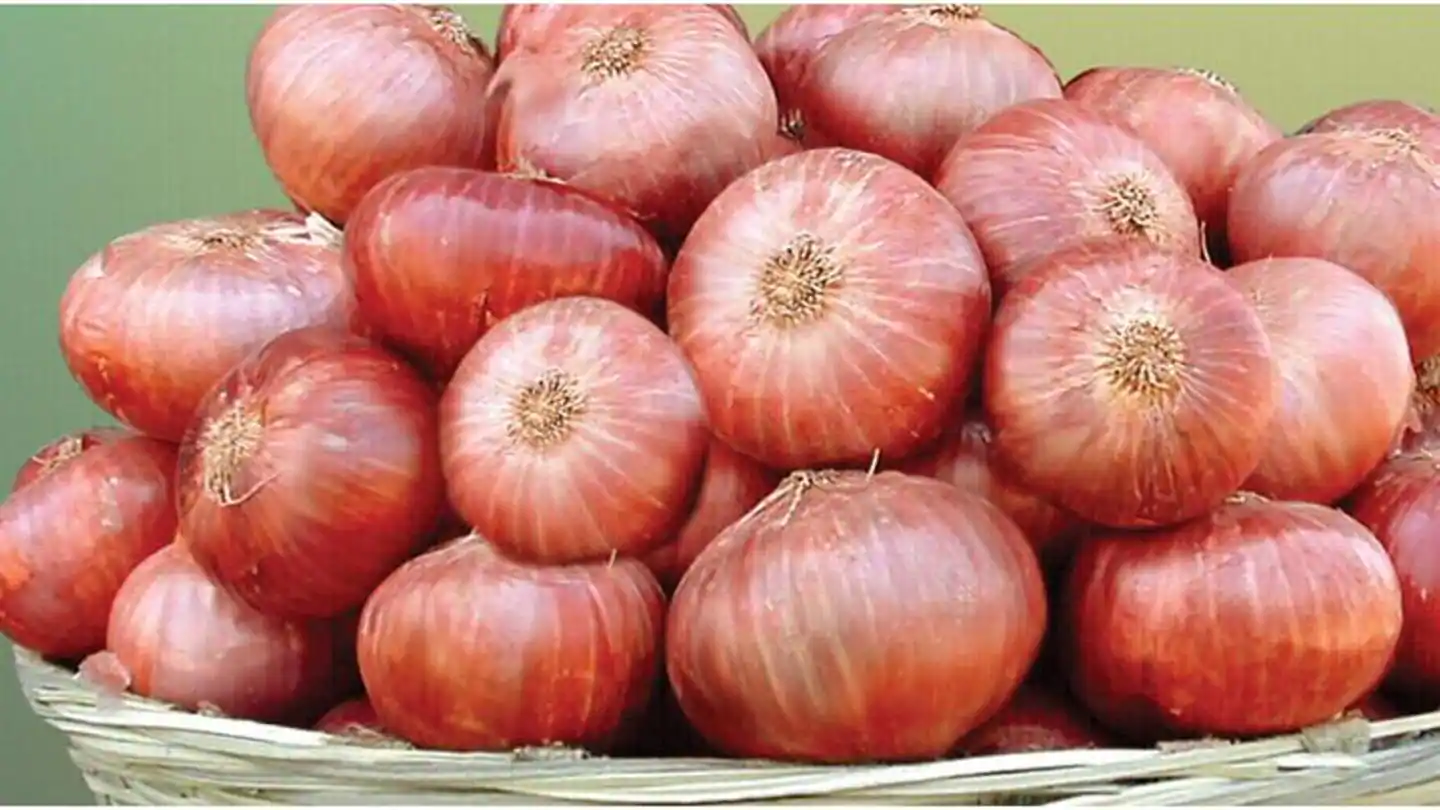
The Government declare that farmers can get $₹\ 300$ per quintal for their onions on $1^{st}$ July and after that, the price will be dropped by $₹\ 3$ per quintal per extra day. Shyams father has $80$ quintal of onions in the field on $1^{st}$ July, and he estimates that crop is increasing at the rate of $1$ quintal per day.

Based on the above information, answer the following questions.
  1. If $x$ is the number of days after $1^{st}$ July, then price and quantity of onion respectively can be expressed as.
  1. $₹\ (300 - 3x), (80 + x)$ quintals
  2. $₹\ (300 - 3x), (80 - x)$ quintals
  3. $₹\ (300 + x), 80$ quintals
  4. None of these
  1. Revenue $R$ as a function of $x$ can be represented as.
  1. $R(x) = 3x^2 - 60x - 24000$
  2. $R(x) = 3x^2 + 60x - 24000$
  3. $R(x) = 3x^2 + 40x - 16000$
  4. $R(x) = 3x^2 - 60x - 14000$
  1. Find the number of days after $1^{st}$ July, when Shyam's father attain maximum revenue.
  1. $10$
  2. $20$
  3. $12$
  4. $22$
  1. On which day should Shyam's father harvest the onions to maximise his revenue?
  1. $11^{th}$ July
  2. $20^{th}$ July
  3. $12^{th}$ July
  4. $22^{nd}$ July
  1. Maximum revenue is equal to.
  1. $₹\ 20,000$
  2. $₹\ 24,000$
  3. $₹\ 24,300$
  4. $₹\ 24,700$
Naina is creative she wants to prepare a sweet box for Diwali at home. She took a square piece of cardboard of side $18 \mathrm{~cm}$ which is to be made into an open box, by cutting a square from each corner and folding up the flaps to form the box. She wants to cover the top of the box with some decorative paper. Naina is interested in maximizing the volume of the box.

Image

(i) Find the volume of the open box formed by folding up the cutting each corner with $\mathrm{x} \mathrm{cm}$.

(ii) Naina is interested in maximizing the volume of the box. So, what should be the side of the square to be cut off so that the volume of the box is maximum?

(iii) Verify that volume of the box is maximum at $x=3 \mathrm{~cm}$ by second derivative test?

OR

Find the maximum volume of the box.

Read the following text carefully and answer the questions that follow :
To teach the application of probability a maths teacher arranged a surprise game for $5$ of his students namely Govind, Girish, Vinod, Abhishek and Ankit. He took a bowl containing tickets numbered $1$ to $50$ and told the students go one by one and draw two tickets simultaneously from the bowl and replace it after noting the numbers.
Image
i. Teacher ask Govind, what is the probability that tickets are drawn by Abhishek, shows a prime number on one ticket and a multiple of $4$ on other ticket? $(1)$
ii. Teacher ask Girish, what is the probability that tickets drawn by Ankit, shows an even number on first ticket and an odd number on second ticket? $(1)$
iii. Teacher asks Abhishek, what is the probability that tickets drawn by Vinod, shows a multiple of $4$ on one ticket and a multiple $5$ on other ticket? $(2)$
OR
Teacher asks Vinod, what is the probability that both tickets drawn by Girish shows odd number? $(2)$
In a college hostel accommodating 1000 students, one of the hostellers came in carrying Corona virus, and the hostel was isolated. The rate at which the virus spreads is assumed to be proportional to the product of the number of infected students and remaining students. There are 50 infected students after 4 days.

Based on the above information, answer the following questions.
  1. If n(I) denote the number of students infected by Corona virus at any time I, then maximum value of n(I) is:
  1. 50
  2. 100
  3. 500
  4. 1000
  1. $\frac{\text{dn}}{\text{dt}}$ is proporuona to:
  1. n(1000 - n)
  2. n(100 + n)
  3. n(100 - n)
  4. n(100 + n)
  1. The value of n(4) is:
  1. 1
  2. 50
  3. 100
  4. 1000
  1. The most general solution of differential equation formed in given situation is:
  1. $\frac{1}{1000}\log\Big(\frac{1000-\text{n}}{\text{n}}\Big)=\lambda\text{t}+\text{c}$
  2. $\log\Big(\frac{\text{n}}{100-\text{n}}\Big)=\lambda\text{t}+\text{c}$
  3. $\frac{1}{1000}\log\Big(\frac{\text{n}}{1000-\text{n}}\Big)=\lambda\text{t}+\text{c}$
  4. None of these.
  1. The value of n at any time is given by:
  1. $\text{n(t)}=\frac{1000}{1+999\text{e}^{-0.9906\text{t}}}$
  2. $\text{n(t)}=\frac{1000}{1-999\text{e}^{-0.9906\text{t}}}$
  3. $\text{n(t)}=\frac{100}{1-999\text{e}^{-0.9906\text{t}}}$
  4. $\text{n(t)}=\frac{100}{1+999\text{e}^{-0.9906\text{t}}}$
Read the following text carefully and answer the questions that follow:
Dinesh is having a jewelry shop at Green Park, normally he does not sit on the shop as he remains busy in political meetings. The manager Lisa takes care of jewelry shop where she sells earrings and necklaces. She gains profit of $₹30$ on pair of earrings $₹40$ on neckless. It takes $30$ minutes to make a pair of earrings and $1$ hour to make a necklace, and there are $10$ hours a week to make jewelry. In addition, there are only enough materials to make $15$ total of jewelry items per week..
Image
$i.$ Formulate the above information mathematically. $(1)$
$ii.$ Graphically represent the given data. $(1)$
$iii.$ To obtain maximum profit how many pair of earing and neckleses should be sold? $(2)$
$OR$
What would be the profit if 5 pairs of earrings and 5 necklaces are made? $(2)$