Question
It is known that, if the interest is compounded continuously, the principal changes at the rate equal to the product of the rate of bank interest per annum and the principal. Let P denotes the principal at any time t and rate of interest be r% per annum.

Based on the above information, answer the following question.
  1. Find the value of $\frac{\text{dP}}{\text{dt}}.$
  1. $\frac{\text{Pr}}{1000}$
  2. $\frac{\text{Pr}}{100}$
  3. $\frac{\text{Pr}}{10}$
  4. $\text{Pr}$
  1. If P0 be the initial principal, then find the solution of differential equation formed in given situation.
  1. $\log\Big(\frac{\text{P}}{\text{P}_0}\Big)=\frac{\text{rt}}{100}$
  2. $\log\Big(\frac{\text{P}}{\text{P}_0}\Big)=\frac{\text{rt}}{10}$
  3. $\log\Big(\frac{\text{P}}{\text{P}_0}\Big)=\text{rt}$
  4. $\log\Big(\frac{\text{P}}{\text{P}_0}\Big)=100\text{rt}$
  1. If the interest is compounded continuously at 5% per annum, in how many years will ₹ 100 double itself?
  1. 12.728 years
  2. 14.789 years
  3. 13.862 years
  4. 15.872 years
  1. At what interest rate will ₹ 100 double itself in 10 years? $(\log_\text{e}2 = 0.6931 ).$
  1. 9.66%
  2. 8.239%
  3. 7.341%
  4. 6.931%
  1. How much will ₹ 1000 be worth at 5% interest after 10 years? (e0.5 = 1.648).
  1. ₹ 1648
  2. ₹ 1500
  3. ₹ 1664
  4. ₹ 1572

Answer

  1. (b) $\frac{\text{Pr}}{100}$

Solution:

Here, P denotes the principal at any time t and the rate of interest be r% per annum compounded continuously, then according to the law given in the problem, we get

$\frac{\text{dP}}{\text{dt}}=\frac{\text{Pr}}{100}$

  1. (a) $\log\Big(\frac{\text{P}}{\text{P}_0}\Big)=\frac{\text{rt}}{100}$

Solution:

We have, $\frac{\text{dP}}{\text{dt}}=\frac{\text{Pr}}{100}$

$\Rightarrow\frac{\text{dP}}{\text{P}}=\frac{\text{r}}{100}\text{dt}$

$\Rightarrow\int\frac{\text{1}}{\text{P}}\text{dP}=\frac{\text{r}}{100}\int\text{dt}$

$\Rightarrow\log\text{P}=\frac{\text{rt}}{100}+\text{C}...\text{(i)}$

$\text{At t}=0,\ \ \text{P}=\text{P}_0.$

$\therefore\ \ \text{C}=\log\text{P}_0$

So, $\log\text{P}=\frac{\text{rt}}{100}+\log\text{p}_0$

$\Rightarrow\log\Big(\frac{\text{P}}{\text{P}_0}\Big)=\frac{\text{rt}}{100}...\text{(ii)}$

  1. (c) 13.862 years

Solution:

We have, r = 5, P= ₹ 100 and P = ₹ 200 = 2P0 Substituting these values in (2), we get

$\log2=\frac{5}{100}\text{t}$

$\Rightarrow\text{t}=20\log_\text{e}$

$2 = 20 × 0.6931\ \text{years} = 13.862\ \text{years}$

  1. (d) 6.931%

Solution:

We have,

P0 = ₹ 100, P = ₹ 200 = 2Pand t = 10 years Substituting these values in (2), we get

$\log2\frac{10\text{r}}{100}\Rightarrow\text{r}=10\log2=10\times0.6931=6.931$

  1. (a) ₹ 1648

Solution:

We have P0 = ₹ 1000, r = 5 and t = 10 Substituting these values in (2), we get

$\log\Big(\frac{\text{P}}{1000}\Big)=\frac{5\times10}{100}=\frac{1}{2}=0.5$

$\Rightarrow\frac{\text{P}}{1000}=\text{e}^{0.5}$

$\Rightarrow\text{ P} = 1000 × 1.648 = ₹ \ 1648$

Need a full question paper?

Generate a complete, print-ready paper with questions like this in minutes — across 16+ boards, with answer keys.

Start Generating Free

Similar questions

If two vectors are represented by the two sides of a triangle taken in order, then their sum is represented by the third side of the triangle taken in opposite order and this is known as triangle law of vector addition. Based on the above information, answer the following questions.
  1. If $\vec{\text{p}},\vec{\text{q}},\vec{\text{r}}$ are the vectors represented by the sides of a triangle taken in order, then $\vec{\text{q}},+\vec{\text{r}}=$
  1. $\vec{\text{p}}$

  2. $2\vec{\text{p}}$

  3. $-\vec{\text{p}}$

  4. None of these
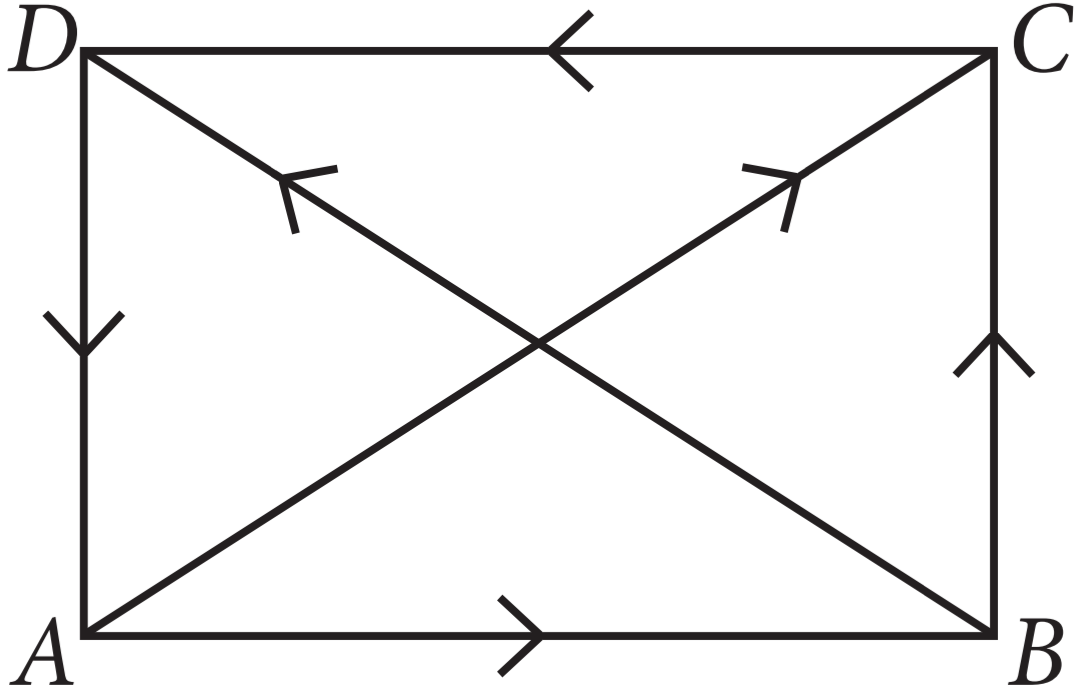
  1. If ABCD is a parallelogram and AC and BD are its diagonals, then $\overline{\text{AC}}+\overline{\text{BD}}=$
  1. $2\overline{\text{DA}}$

  2. $2\overline{\text{AB}}$

  3. $2\overline{\text{BC}}$

  4. $2\overline{\text{BD}}$

  1. If ABCD is a parallelogram, where $\overline{\text{AB}}=2\vec{\text{a}}$ and $\overline{\text{BC}}=2\vec{\text{b}},$ then $\overline{\text{AC}}-\overline{\text{BD}}=$
  1. $3\vec{\text{a}}$

  2. $4\vec{\text{a}}$

  3. $2\vec{\text{b}}$

  4. $4\vec{\text{b}}$

  1. If ABCD is a quadrilateral whose diagonals are $\overline{\text{AC}}$ and $\overline{\text{BD}},$ then $\overline{\text{BA}}+\overline{\text{DC}}=$

  1. $\overline{\text{AC}}+\overline{\text{DB}}$

  2.  $\overline{\text{AC}}+\overline{\text{BD}}$

  3. $\overline{\text{BC}}+\overline{\text{AD}}$

  4. $\overline{\text{BD}}+\overline{\text{CA}}$

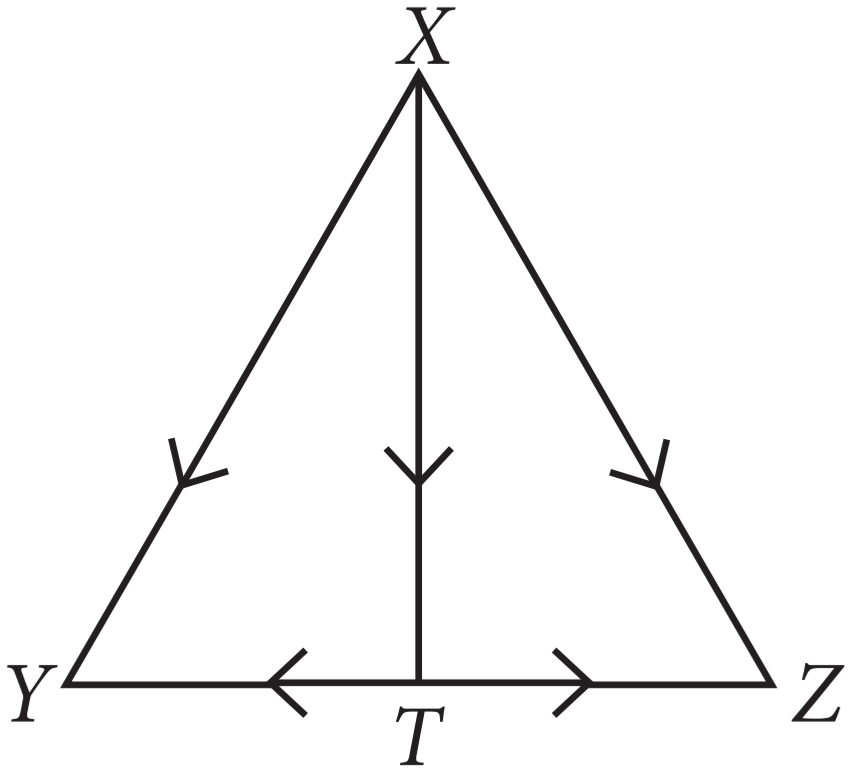
  1. If T is the mid point of side YZ of $\triangle\text{XYZ},$ then $\overline{\text{XY}}+\overline{\text{XZ}}=$

  1. $2\overline{\text{YT}}$

  2. $2\overline{\text{XT}}$

  3. $2\overline{\text{TZ}}$

  4. None of these
A factory has three machines A, B and C to manufacture bolts. Machine A manufacture 30%, machine B manufacture 20% and machine C manufacture 50% of the bolts respectively. Out of their respective outputs 5%, 2% and 4% are defective. A bolt is drawn at random from total production and it is found to be defective.

Based on the above information, answer the following questions.
  1. Probability that defective bolt drawn is manufactured by machine A, is:
  1. $\frac{4}{13}$

  2. $\frac{5}{13}$

  3. $\frac{6}{13}$

  4. $\frac{9}{13}$
  1. Probability that defective bolt drawn is manufactured by machine B, is:
  1. 0.3
  2. 0.1
  3. 0.2
  4. 0.4
  1. Probability that defective bolt drawn is manufactured by machine C, is:
  1. $\frac{16}{39}$

  2. $\frac{17}{39}$

  3. $\frac{20}{39}$

  4. $\frac{15}{39}$

  1. Probability that defective bolt is not manufactured by machine B, is:
  1. $\frac{35}{39}$

  2. $\frac{61}{39}$

  3. $\frac{41}{39}$

  4. None of these.

  1. Probability that defective bolt is not manufactured by machine C, is:
  1. 0.03
  2. 0.09
  3. 0.5
  4. 0.9 
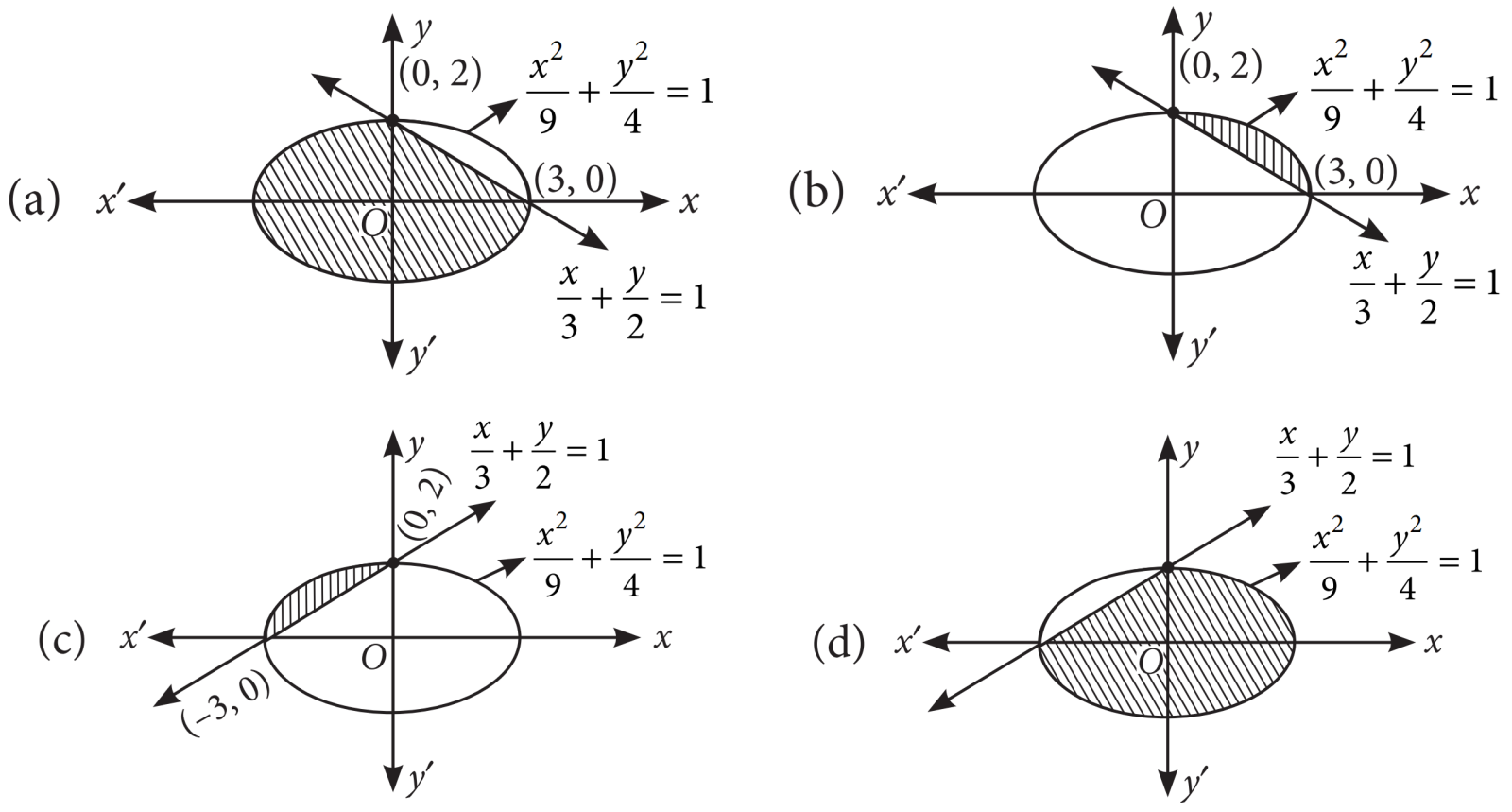
A mirror in the shape of an ellipse represented by $\frac{\text{x}^2}{9}+-\frac{\text{y}^2}{4}=1$ was hanging on the wall. Arun and his sister were playing with ball inside the house, even their mother refused to do so. All of sudden, ball hit the mirror and got a scratch in the shape of line represented by $\frac{\text{x}}{3}+\frac{\text{y}}{2}=1$

Based on the above information, answer the following questions.
  1. Point(s) of intersection of ellipse and scratch (straight line) is (are).
  1. (0, 2), (3, 0)
  2. (2, 0), (3, 0)
  3. (2, 3), (0, 0)
  4. (0, 3), (3, 0)
  1. Area of smaller region bounded by the ellipse and line is represented by.

  1. The value of $\frac{2}{3}\int\limits_{0}^{3}\sqrt{9-\text{x}^2}\text{dx}$ is.
    1. $\frac{\pi}{2}$

    2. $\pi$

    3. $\frac{3\pi}{2}$

    4. $\frac{\pi}{4}$

  1. The value of  $2\int\limits_{0}^{3}\bigg(1-\frac{\text{x}}{3}\bigg)\text{dx}$ is.
    1. 0
    2. 1
    3. 2
    4. 3
  1. Area of the smaller region bounded by the mirror and scratch is.
  1. $3\Big(\frac{\pi}{2}+1\Big)\text{ sq.units}$

  2. $\Big(\frac{\pi}{2}+1\Big)\text{ sq.units}$

  3. $\Big(\frac{\pi}{2}-1\Big)\text{ sq.units}$

  4. $3\Big(\frac{\pi}{2}-1\Big)\text{ sq.units}$

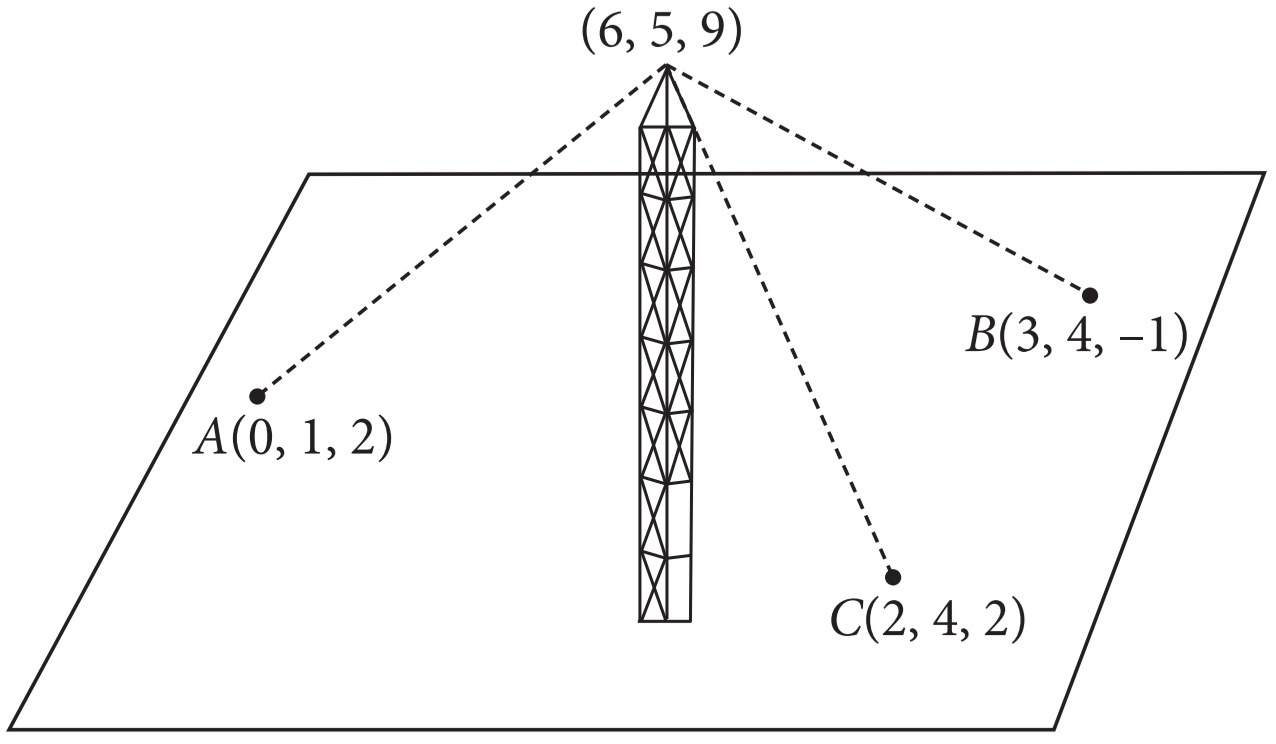
A mobile tower stands at the top of a hill. Consider the surface on which tower stand as a plane having points A(0, 1, 2), B(3, 4, -1), and C(2, 4, 2) on it. The mobile tower is tied with 3 cables from the point A, Band C such that it stand vertically on the ground. The peak of the tower is at the point ( 6, 5, 9), as shown in the figure.

Based on the above information, answer the following questions.

  1. The equation of plane passing through the points A, Band C is:
  1. 3x - 4y + z = 0
  2. 3x - 2y + z = 0
  3. 3x - 2y + z = 0
  4. 4x - 3y + 3z = 0
  1. The height of the tower from the ground is:
  1. 6 units
  2. 5 units
  3. $\frac{17}{\sqrt{14}}\text{units}$

  4. $\frac{5}{\sqrt{14}}\text{units}$

  1. The equation of line of perpendicular drawn from the peak of tower to the ground is:
  1. $\frac{\text{x}-6}{3}=\frac{\text{y}-4}{-2}=\frac{\text{z}-9}{1}$

  2. $\frac{\text{x}-6}{3}=\frac{\text{y}-5}{-2}=\frac{\text{z}-9}{1}$

  3. $\frac{\text{x}-6}{3}=\frac{\text{y}-4}{2}=\frac{\text{z}-9}{1}$

  4. $\frac{\text{x}-6}{3}=\frac{\text{y}-5}{2}=\frac{\text{z}-9}{1}$

  1. The coordinates of foot of perpendicular drawn from the peak of tower to the ground are:
  1. $\Big(\frac{33}{14},\frac{104}{14},\frac{109}{14}\Big)$

  2. $\Big(\frac{33}{14},\frac{109}{14},\frac{104}{14}\Big)$

  3. $\Big(\frac{33}{14},\frac{105}{14},\frac{109}{14}\Big)$

  4. None of these
  1. The area of $\triangle\text{ABC}$ is:
  1. $\frac{1}{2}\sqrt{14}\text{sq}.\text{units}$

  2. $\frac{3}{2}\sqrt{14}\text{sq}.\text{units}$

  3. $\sqrt{14}\text{sq}.\text{units}$

  4. $2\sqrt{14}\text{sq}.\text{units}$

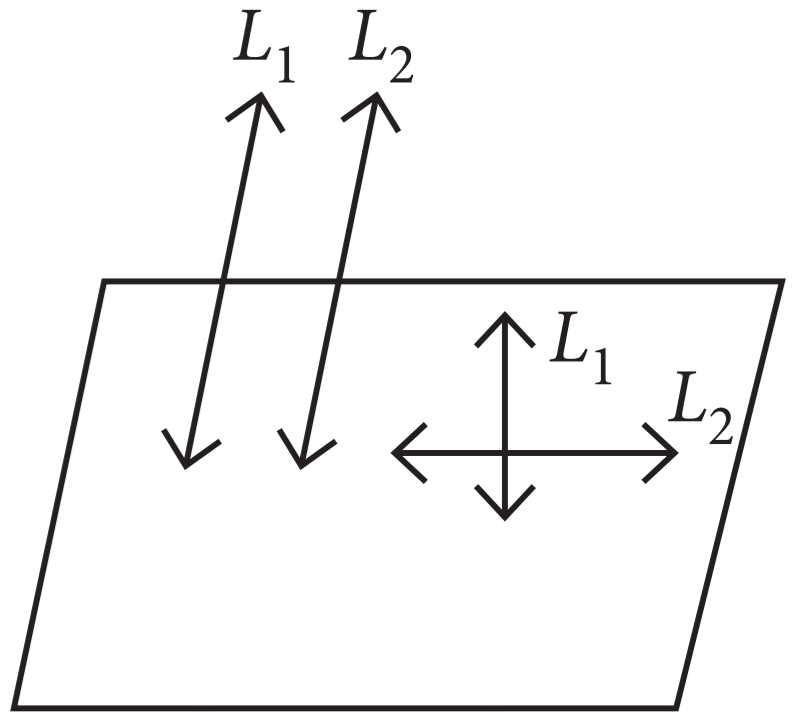
If a1, b1, c1, and a2, b2, c2 are direction ratios of two lines say L1 and L2 respectively. Then L1 || L2 iff $\frac{\text{a}_1}{\text{a}_2}=\frac{\text{b}_1}{\text{b}_2}=\frac{\text{c}_1}{\text{c}_2}$ and $\text{L}_1\perp\text{L}_2$ iff a1a2 + b1b2 + c1c2 = 0.

Based on the above information, answer the following questions.

  1. If l1, m1,  n1, and l2, m2, n2 are the direction cosines of L1 and L2 respectively, then L1 will be perpendicular to L2, iff:
  1. l1l2 + m1m2 + n1n2 = 0
  2. l1m2 + m1l2 + n1n2 = 0
  3. $\frac{\text{l}_1}{\text{l}_2}=\frac{\text{m}_1}{\text{m}_2}=\frac{\text{n}_1}{\text{n}_2}$

  4. None of these
  1. If l1, m1, n1 and l2, m2, n2 are direction cosines of L1 and L2 respectively, then L1 will be parallel to L2, iff:
  1. l1l2 + m1m2 + n1n2 = 0
  2. l1m2 + m1l2 + n1n2 = 0
  3. $\frac{\text{l}_1}{\text{l}_2}=\frac{\text{m}_1}{\text{m}_2}=\frac{\text{n}_1}{\text{n}_2}$

  4. m1n2 + m2n2 + l1l2 = 0
  1. The coordinates of the foot of the perpendicular drawn from the point A(1, 2, 1) to the line joining B(1, 4, 6) and C(5, 4, 4), are:
  1. (1, 2, 1)
  2. (2, 4, 5)
  3. (3, 4, 5)
  4. (3, 4, 5)
  1. The direction ratios of the line which is perpendicular to the lines with direction ratios proportional to (1, -2, -2) and (0, 2, 1) are:
  1. < 1, 2, 1 >
  2. < 2,-1, 2 >
  3. < -1,2, 2 >
  4. None of these
  1. The lines $\frac{\text{x}-2}{3}=\frac{\text{y}+1}{-2}=\frac{\text{z}-2}{0}$ and $\frac{\text{x}-1}{1}=\frac{\frac{\text{y}+3}{2}}{\frac{3}{2}}=\frac{\text{z}+5}{2}$ are:
  1. Parallel.
  2. Perpendicular.
  3. Skew lines.
  4. Non-intersecting.
A relation R on a set A is said to be an equivalence relation on A iff it is:
  1. Reflexive i.e., $(\text{a, a})\in\ \text{R} \ \forall \ \text{a}\in\text{A}.$
  2. Symmetric i.e., $(\text{a, b})\in\ \text{R} \Rightarrow \text{(b, a) } \in\text{R}\ \forall \ \text{a, b}\in\text{A}.$
  3. Transitive i.e., $(\text{a, b})\in\ \text{R} \ \text{and}\ \text{(b, c) } \in\text{R}\Rightarrow\text{(a, c)}\in\text{R}\ \forall \ \text{a, b, c}\in\text{A}.$
Based on the above information, answer the following questions.
  1. If the relation R = {(1, 1), (1, 2), (1, 3), (2, 2), (2, 3), (3, 1), (3, 2), (3, 3)} defined on the set A = {1, 2, 3}, then R is:
  1. Reflexive
  2. Symmetric
  3. Transitive
  4. Equivalence
  1. If the relation R = {(1, 2), (2, 1), (1, 3), (3, 1)} defined on the set A = {1, 2, 3}, then R is:
  1. Reflexive
  2. Symmetric
  3. Transitive
  4. Equivalence
  1. If the relation R on the set N of all natural numbers defined as R = {(x, y): y = x + 5 and x < 4}, then R is:
  1. Reflexive
  2. Symmetric
  3. Transitive
  4. Equivalence
  1. If the relation R on the set A = {1, 2, 3, ........., 13, 14} defined as R = {(x, y): 3x - y = O}, then R is:
  1. Reflexive
  2. Symmetric
  3. Transitive
  4. Equivalence
  1. If the relation R on the set A = {I, 2, 3} defined as R = {(1, 1), (1, 2), (1, 3), (2, 1), (2, 2), (2, 3), (3, 1), (3, 2), (3, 3)}, then R is:
  1. Reflexive only
  2. Symmetric only
  3. Transitive only
  4. Equivalence
Two schools A and B want to award their selected students on the values of Honesty, Hard work and Punctuality. The school A wants to award ₹ x each, ₹ y each and ₹ z each for the three respective values to its 3, 2 and 1 students respectively with a total award money of ₹ 2200. School B wants to spend ₹ 3100 to award its 4, 1 and 3 students on the respective values (by giving the same award money to the three values as school A). The total amount of award for one prize on each value is ₹ 1200.

Using the concept of matrices and determinants, answer the following questions.
  1. What is the award money for Honesty?
  1. ₹ 350
  2. ₹ 300
  3. ₹ 500
  4. ₹ 400
  1. What is the award money for Punctuality?
  1. ₹ 300
  2. ₹ 280
  3. ₹ 450
  4. ₹ 500
  1. What is the award money for Hard work?
  1. ₹ 500
  2. ₹ 400
  3. ₹ 300
  4. ₹ 550
  1. If a matrix P is both symmetric and skew-symmetric, then |P| is equal to:
  1. 1
  2. -1
  3. 0
  4. None of these.
  1. If P and Qare two matrices such that PQ = Q and QP = P, then |Q2| is equal to:
  1. |Q|
  2. |P|
  3. 1
  4. 0
A mobile tower stands at the top of a hill. Consider the surface on which tower stand as a plane having points A(0, 1, 2), B(3, 4, -1), and C(2, 4, 2) on it. The mobile tower is tied with 3 cables from the point A, Band C such that it stand vertically on the ground. The peak of the tower is at the point ( 6, 5, 9), as shown in the figure.

Based on the above information, answer the following questions.

  1. The equation of plane passing through the points A, Band C is:
  1. 3x - 4y + z = 0
  2. 3x - 2y + z = 0
  3. 3x - 2y + z = 0
  4. 4x - 3y + 3z = 0
  1. The height of the tower from the ground is:
  1. 6 units
  2. 5 units
  3. $\frac{17}{\sqrt{14}}\text{units}$

  4. $\frac{5}{\sqrt{14}}\text{units}$

  1. The equation of line of perpendicular drawn from the peak of tower to the ground is:
  1. $\frac{\text{x}-6}{3}=\frac{\text{y}-4}{-2}=\frac{\text{z}-9}{1}$

  2. $\frac{\text{x}-6}{3}=\frac{\text{y}-5}{-2}=\frac{\text{z}-9}{1}$

  3. $\frac{\text{x}-6}{3}=\frac{\text{y}-4}{2}=\frac{\text{z}-9}{1}$

  4. $\frac{\text{x}-6}{3}=\frac{\text{y}-5}{2}=\frac{\text{z}-9}{1}$

  1. The coordinates of foot of perpendicular drawn from the peak of tower to the ground are:
  1. $\Big(\frac{33}{14},\frac{104}{14},\frac{109}{14}\Big)$

  2. $\Big(\frac{33}{14},\frac{109}{14},\frac{104}{14}\Big)$

  3. $\Big(\frac{33}{14},\frac{105}{14},\frac{109}{14}\Big)$

  4. None of these
  1. The area of $\triangle\text{ABC}$ is:
  1. $\frac{1}{2}\sqrt{14}\text{sq}.\text{units}$

  2. $\frac{3}{2}\sqrt{14}\text{sq}.\text{units}$

  3. $\sqrt{14}\text{sq}.\text{units}$

  4. $2\sqrt{14}\text{sq}.\text{units}$

Western music concert is organised every year in the stadium that can hold 36000 spectators. With ticket price of ₹ 10, the average attendance has been 24000. Some financial expert estimated that price of a ticket should be determined by the function.
$\text{p}(\text{x})=15-\frac{\text{x}}{3000}$ where x is the number of tickets sold.

Based on the above information, answer the following questions.
  1. The revenue, R as a function of x can be represented as.
  1. $15\text{x}-\frac{\text{x}^2}{3000}$
  2. $15-\frac{\text{x}^2}{3000}$
  3. $15\text{x}-\frac{1}{3000}$
  4. $15\text{x}-\frac{\text{x}}{3000}$
  1. The range of x is.
  1. [24000, 36000]
  2. [0, 24000]
  3. [0, 36000]
  4. None of these
  1. The value of x for which revenue is maximum, is.
  1. 20000
  2. 21000
  3. 22500
  4. 25000
  1. When the revenue is maximum, the price of the ticket is.
  1. ₹ 5
  2. ₹ 5.5
  3. ₹ 7
  4. ₹ 7.5
  1. How many spectators should be present to maximize the revenue?
  1. 21500
  2. 21000
  3. 22000
  4. 22500
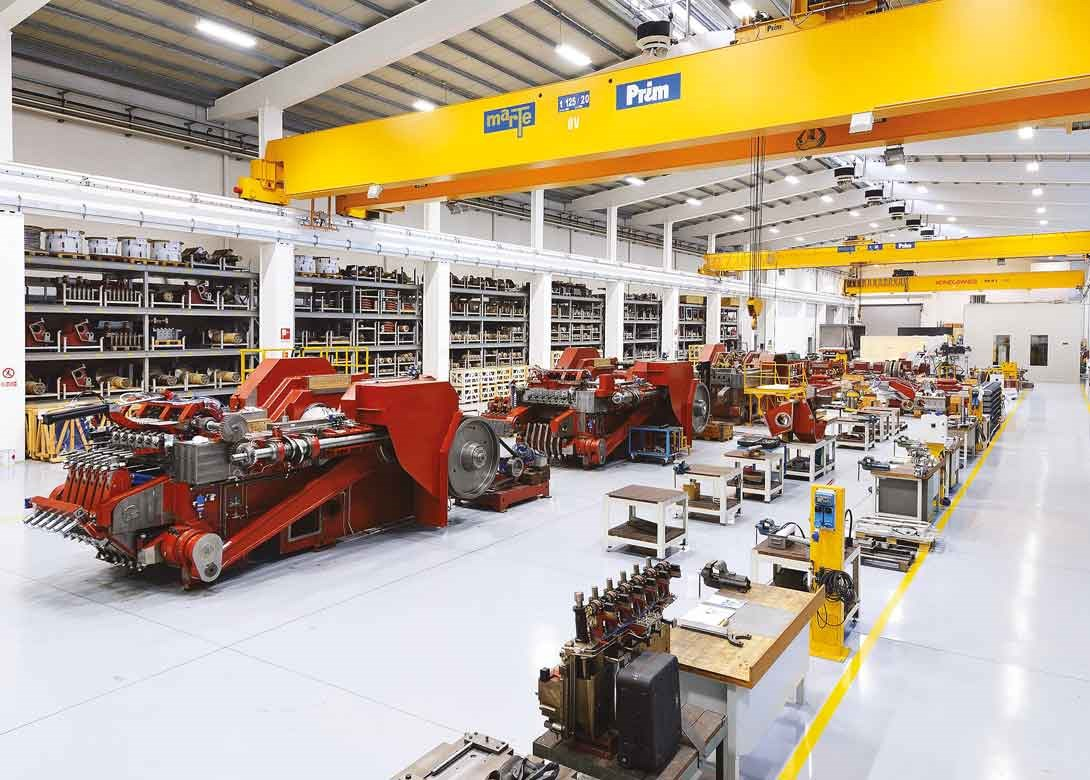
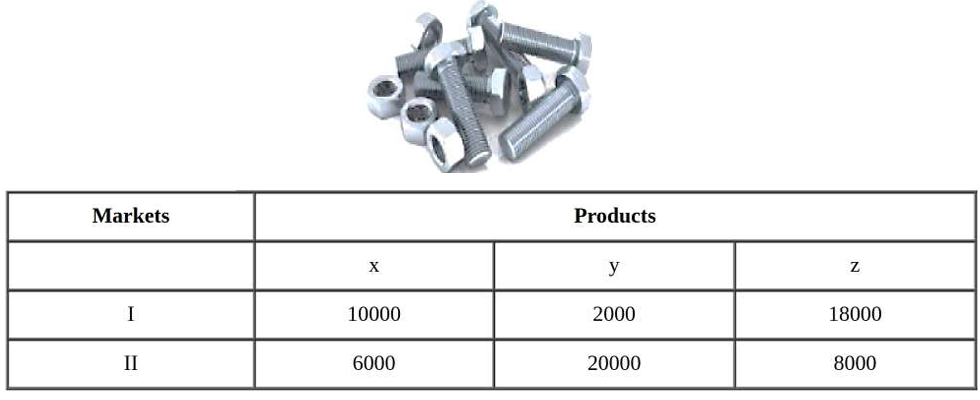
The nut and bolt manufacturing business has gained popularity due to the rapid Industrialization and introduction of the Capital-Intensive Techniques in the Industries that are used as the Industrial fasteners to connect various machines and structures. Mr. Suresh is in Manufacturing business of Nuts and bolts. He produces three types of bolts, $\mathrm{x}, \mathrm{y}$, and $\mathrm{z}$ which he sells in two markets. Annual sales (in ₹) indicated below:

Image

(i) If unit sales prices of $x, y$ and $z$ are $₹ 2.50$, ₹ 1.50 and $₹ 1.00$ respectively, then find the total revenue collected from Market-I \&II.

(ii) If the unit costs of the above three commodities are ₹2.00, ₹ 1.00 and 50 paise respectively, then find the cost price in Market I and Market II.

(iii) If the unit costs of the above three commodities are ₹2.00, ₹1.00 and 50 paise respectively, then find gross profit from both the markets.

OR

If matrix $\mathrm{A}=\left[a_{i j}\right]_{2 \times 2}$ where $\mathrm{a}_{\mathrm{ij}}=1$, if $\mathrm{i} \neq \mathrm{j}$ and $\mathrm{a}_{\mathrm{ij}}=0$, if $\mathrm{i}=\mathrm{j}$ then find $\mathrm{A}^2$.