MCQ
It is possible to distinguish between the transverse and longitudinal waves by studying the property of
  • A
    Interference
  • B
    Diffraction
  • C
    Reflection
  • Polarisation

Answer

Correct option: D.
Polarisation
d
(d) Interference, diffraction and reflection occurs in both transverse and longitudinal waves.

Polarisation occurs only in transverse waves.

Need a full question paper?

Generate a complete, print-ready paper with questions like this in minutes — across 16+ boards, with answer keys.

Start Generating Free

Similar questions

If $R$ is the radius of the earth and $g$ the acceleration due to gravity on the earth's surface, the mean density of the earth is
The plot of the number $(N)$ of decayed atoms versus activity $(A)$ of a radioactive substance is
$A$ point source of light is placed at a distance $h$ below the surface of alarge deep lake.What is the percentage of light energy that escapes directly from the water surface is $\mu$ of the water $=4/3?$........$\%$ (neglect partial reflection)
A pendulum clock is set to give correct time at the sea level. This clock is moved to hill station at an altitude of $2500\, m$ above the sea level. In order to keep correct time of the hill station, the length of the pendulum
The refractive index of a prism for a monochromatic wave is $\sqrt 2 $ and its refracting angle is $60^o $. For minimum deviation, the angle of incidence will be......$^o$
In a parallel plate capacitor of capacitance $C$, a metal sheet is inserted between the plates, parallel to them. If the thickness of the sheet is half of the separation between the plates. The capacitance will be
A bomb of $12\, kg$ explodes into two pieces of masses $4\, kg$ and $8\, kg$. The velocity of $8\, kg$ mass is $6\, m/sec$. The kinetic energy of the other mass is .............. $\mathrm{J}$
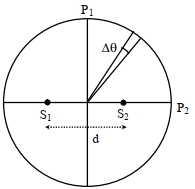
Two coherent monochromatic point sources $S_1$ and $S_2$ of wavelength $\lambda=600 \mathrm{~nm}$ are placed symmetrically on either side of the centre of the circle as shown. The sources are separated by a distance $d=1.8 ~mm$. This arrangement produces interference fringes visible as alternate bright and dark spots on the circumference of the circle. The angular separation between two consecutive bright spots is $\Delta \theta$. Which of the following options is/are correct?

(image)

$[A]$ A dark spot will be formed at the point $\mathrm{P}_2$

$[B]$ At $P_2$ the order of the fringe will be maximum

$[C]$ The total number of fringes produced between $P_1$ and $P_2$ in the first quadrant is close to $3000$

$[D]$ The angular separation between two consecutive bright spots decreases as we move from $P_1$ to $P_2$ along the first quadrant
There are two points $P$ and $Q$ on a projectile with velocities $v_P$ and $v_Q$ respectively such that $v_P$ is perpendicular to $v_Q$ and $\alpha$ is the angle that $v_P$ makes with horizontal at point $P$. Find the correct option
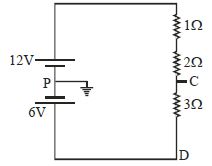
Find potential at point $C$ and $D$