- AThe wires attract each other.
- BThe wires repel each other.
- CThe wires experience neither attraction nor repulsion.
- DThe forces of attraction or repulsion do not depend on current direction.
Explanation:
If two parallel wires carry current in opposite directions, they repel each other whereas if two parallel wires carry current in same direction, they attract each other.
Generate a complete, print-ready paper with questions like this in minutes — across 16+ boards, with answer keys.
The magnetic needle of a tangent galvanometer is deflected at an angle 30o due to a magnet. The horizontal component of earth’s magnetic field 0.34 × 10⁻⁴ T is along the plane of the coil. The magnetic intensity is
|
(a) 1.96 × 10⁻⁴ T |
(b) 1.96 × 10⁻⁵ T |
(c) 1.96 × 10⁴ T |
(d) 1.96 × 10⁵ T |
A power line lies along the east-west direction and carries a current of 10 ampere. The force per metre due to the earth's magnetic field of is
|
(a) |
(b) |
(c) |
(d) |
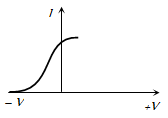
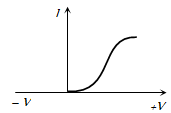
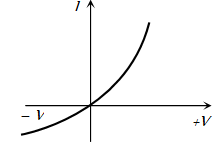
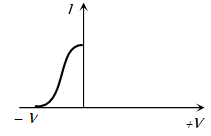
Different voltages are applied across a P-N junction and the currents are measured for each value. Which of the following graphs is obtained between voltage and current
(a)
|
(b)
|
(c)
|
(d)
|
Two capacitors of capacitances 3 μF and 6 μF are charged to a potential of 12 V each. They are now connected to each other, with the positive plate of each joined to the negative plate of the other. The potential difference across each will be
|
(a) 6 volt |
(b) 4 volt |
(c) 3 volt |
(d) Zero |
The material of permanent magnet has
| (a) High retentivity, low coercivity | (b) Low retentivity, high coercivity |
| (c) Low retentivity, low coercivity | (d) High retentivity, high coercivity |
Two galvanometers A and B require 3mA and 5mA respectively to produce the same deflection of 10 divisions. Then
|
(a) A is more sensitive than B |
(b) B is more sensitive than A |
|
(c) A and B are equally sensitive |
(d) Sensitiveness of B is 5/3 times that of A |
The photoelectric threshold wavelength for a metal surface is 6600 Å. The work function for this is
|
(a) 1.87 V |
(b) 1.87 eV |
(c) 18.7 eV |
(d) 0.18 eV |