MCQ
$IUPAC$  name for $K\left[ {Ag{{\left( {CN} \right)}_2}} \right]$ is
  • A
    Potassium argentocyanide
  • B
    Potassium silver cyanide
  • Potassium dicyanoargentate $ (I)$ 
  • D
    Potassium dicyanosilver $(II)$ 

Answer

Correct option: C.
Potassium dicyanoargentate $ (I)$ 
c
IUPAC name for $K \left[ Ag ( CN )_2\right]$ is Potassium $dicyanoargentate(I)$. Here the complex ion is formed by the anion part with $Ag$ as the central metal atom which is in $+1$ oxidation state.

Need a full question paper?

Generate a complete, print-ready paper with questions like this in minutes — across 16+ boards, with answer keys.

Start Generating Free

Similar questions

The disproportionation of $MnO _{4}^{2-}$ in acidic medium resulted in the formation of two manganese compounds $A$ and $B$. If the oxidation state of $Mn$ in $B$ is smaller than that of $A$, then the spin-only magnetic moment $(\mu)$ value of $B$ in $BM$ is $.........$ (Nearest integer)
Reaction : $2Br^{-} + H_2O_2 + 2H^{+} \to  Br_2 + 2H_2O$

take place in two steps :

$(a)$ $Br^{-} + H^{+} + H_2O_2 \xrightarrow{{slow}} HOBr + H_2O$

$(b)$ $HOBr + Br^{-} + H^{+} \xrightarrow{{fast}} H_2O + Br_2$

The order of the reaction is 
Which polymer have $C-O-C$ linkage
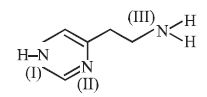
Which of the following is true for geometry of different $N$ present in histamine
The correct order of the solubility of the different alcohols in water is
Among the following amines, the strongest Bronsted base is __________.

Two liquid $A$ and $B$ have vapour pressure in the ratio $P_A^o\,:\,P_B^o\, = \,1:\,3$ at a certain temperature. If the ratio of mole fractions of $A$ to $B$ in the vapour phase is $4 : 3,$ then the mole fraction of $B$ in the solution at the same temperature is
Rank in order of increasing rate of reaction towards $EAS$ with bromine in the presence of $FeBr_3$
$X-O-X$ linkage present in $[X = P/S/Cl/Mn]$

$(a) P_2O_7^{4-}$                                           $(b) S_2O_5^{2-}$

$(c) S_2O_7^{2-}$                                            $(d) Cl_2O_7$

$(e) Mn_2O_7$                                         $(f) S_2O_8^{2-}$

The reactions of $Cl _2$ gas with cold-dilute and hot-concentrated $NaOH$ in water give sodium salts to two (different) oxoacids of chlorine, $P$ and $Q$, respectively. The $Cl _2$ gas reacts with $SO _2$ gas, in presence of charcoal, to give a product $R$. $R$ reacts with white phosphours to give a compound $S$. On hydrolysis, $S$ gives an oxoacid of phosphours $T$

$1.$ $P$ and $Q$, respectively, are the sodium salts of

$(A)$ hypochlorus and chloric acids

$(B)$ hypochlorus and chlorus acids

$(C)$ chloric and perchloric acids

$(D)$ chloric and hypochlorus acids

$2.$ $R , S$ and $T$, respectively, are

$(A)$ $SO _2 Cl _2, PCl _5$ and $H _3 PO _4$

$(B)$ $SO _2 Cl _2, PCl _3$ and $H _3 PO _3$

$(C)$ $SOCl _2, PCl _3$ and $H _3 PO _2$

$(D)$ $SOCl _2, PCl _5$ and $H _3 PO _4$

Give the answer question $1$ and $2.$