MCQ
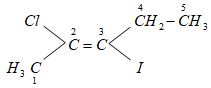
$IUPAC$ name for the compound
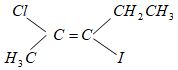
- Atrans $3$ iodo, $4$-chloro, $3$-pentene
- Bcis $3$ chloro, $3$-iodo, $2$-pentene
- ✓trans $2$ chloro, $3$-iodo, $2$-pentene
- Dcis $3$ iodo, $4$-chloro, $3$-pentene
Generate a complete, print-ready paper with questions like this in minutes — across 16+ boards, with answer keys.
$(I)$ $B + AN{O_3} \longrightarrow BN{O_3} + A$
$(II)$ $A + HCl \longrightarrow ACl + \frac{1}{2}\,{H_2}$
$(III)$ $D + ECl \longrightarrow DCl + E$
$(IV)$ $D + HN{O_3} \longrightarrow {H_2}$ gas is not evolved
$C{l_2} + 2B{r^ - }\left( {aq} \right) \to 2C{l^ - }\left( {aq} \right) + B{r_2}$
$Br_2$ gas thus formed is dissolved into solution of $Na_2CO_3$ and then pure $Br_2$ is obtained by treatment of the solution with
Given $SO_3(g) + H_2O(l) \rightarrow H_2SO_4(l)$
$\Delta H = -130\,\, kcal\, mol^{-1}$
$SO_2(g) + 1/2O_2(g) \rightarrow SO_3(g)$
$\Delta H = -100 \,\,kcal\,\, mol^{-1}$
the enthalpy of formation of $H_2SO_4(l)$ would be ......$kcal\, mol^{-1}$