- A$1, 2-$ dichloroethane
- B$2, 2-$ dichloroethane
- ✓$1, 1-$ dichloroethane
- DDichloroethane
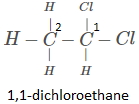
The parent alkane containing two carbon atoms is called as ethane and hence the IUPAC name of this compound is $1,1$-Dichloroethane.
Generate a complete, print-ready paper with questions like this in minutes — across 16+ boards, with answer keys.
$L(1s^2, 2s^2 2p^4); Q(1s^2, 2s^2 2p^6, 3s^2 3p^5)$
$P(1s^2, 2s^2 2p^6, 3s^1); R(1s^2, 2s^2 2p^6, 3s^2)$
The formulae of ionic compounds that can be formed between these elements are
$\mathrm{Eu}^{3+}, \mathrm{Lu}^{3+}, \mathrm{Nd}^{3+}, \mathrm{La}^{3+}, \mathrm{Sm}^{3+}$
Reason : The third ionization energy of $Mn$ is larger than that of $Cr$.
$(A)$ Pentane
$(B)\,2-$ Methyl butane
$(C)\,2,2-$ Dimethyl propane
Assertion $A$: In the photoelectric effect, the electrons are ejected from the metal surface as soon as the beam of light of frequency greater than threshold frequency strikes the surface.
Reason $R$ : When the photon of any energy strikes an electron in the atom, transfer of energy from the photon to the electron takes place.
In the light of the above statements, choose the most appropriate answer from the options given below :