MCQ
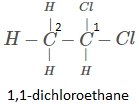
$IUPAC $ name of $H - \mathop {\mathop {\mathop {\mathop C\limits^| }\limits^H }\limits_| }\limits_H - \mathop {\mathop {\mathop {\mathop C\limits^| }\limits^{Cl} }\limits_| }\limits_H - Cl$ is
  • A
    $1, 2-$ dichloroethane
  • B
    $2, 2-$ dichloroethane
  • $1, 1-$ dichloroethane
  • D
    Dichloroethane

Answer

Correct option: C.
$1, 1-$ dichloroethane
c
The numbering of carbon chain is done from the carbon which is having two chlorine atoms.

The parent alkane containing two carbon atoms is called as ethane and hence the IUPAC name of this compound is $1,1$-Dichloroethane.

Need a full question paper?

Generate a complete, print-ready paper with questions like this in minutes — across 16+ boards, with answer keys.

Start Generating Free

Similar questions

Given below are two statements: one is labelled as Assertion A and the other is labelled as Reason $R$.

Assertion $A$ :Phenolphthalein is a $pH$ dependent indicator, remains colourless in acidic solution and gives pink colour in basic medium

Reason $R$ : Phenolphthalein is a weak acid. It doesn't dissociate in basic medium.

In the light of the above statements, choose the most appropriate answer from the options given below.

Which carbocation is the most stable ?
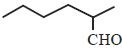
has correct $IUPAC$ name
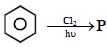
Which among the following statement is not correct for above reaction ?
Maximum bond angle is present in
The complete combustion of $0.492\, g$ of an organic compound containing $'C', 'H'$ and $'O'$ gives $0.793\, g$ of $CO _{2}$ and $0.442\,g$ of $H _{2} O$. The percentage of oxygen composition in the organic compound is .... (nearest integer)
The correct $IUPAC$ name of compound :

$\begin{array}{*{20}{c}}
  {C{H_3} - C{H_2} - C - CH - CHO} \\ 
  {\,\,\,\,\,\,\,\,||\,\,\,\,\,\,\,\,\,|} \\ 
  {\,\,\,\,\,\,\,\,\,\,\,\,\,O\,\,\,\,\,\,\,CN} 
\end{array}$

is :

If $K_{sp}$ of $Ag_2CO_3$ is $8 \times10^{-12},$ the molar solubility of $Ag_2CO_3$ in $0.1\,M\,AgNO_3$ is
If $S + {O_2} \to S{O_2};\,(\Delta H = - 298.2)$ $S{O_2} + \frac{1}{2}{O_2} \to S{O_3};\,(\Delta H = - 98.2)$$S{O_3} + {H_2}O \to {H_2}S{O_4};\,(\Delta H = - 130.2)$ ${H_2} + \frac{1}{2}{O_2} \to {H_2}O;\,(\Delta H = - 287.3)$ then the enthalpy of formation of ${H_2}S{O_4}$ at $298\,K $ will be......$kJ$
Species isoelectronic with $BF_3$ would be