MCQ
$\text{IUPAC}$ name of ​$\text{CH}_3​−\text{O}−\text{CH}−\text{CH}_3 \\ \ \ \ \ \ \ \ \ \ \ \ \ \ \ \ \ \ \ \ \ \ |\\ \ \ \ \ \ \ \ \ \ \ \ \ \ \ \ \ \ \ \ \text{CH}_3$ is $ ........$
  • A
    $3-$ Methoxy propane
  • B
    $2-$ Methyl methoxy ethane
  • C
    $1-$ Methoxy $-1-$ methyl ethane
  • Methoxy isopropane

Answer

Correct option: D.
Methoxy isopropane
The $\text{IUPAC}$ name of the given compound is methoxy isopropane.

Need a full question paper?

Generate a complete, print-ready paper with questions like this in minutes — across 16+ boards, with answer keys.

Start Generating Free

Similar questions

Which one of the following pairs represents stereoisomerism
For the process, $\ce{H_2O(l) \rightarrow H_2O(g) }$ at $T = 100^\circ C$ and $1$ atm, the correct choice is :
The number of all types of isomers of chlorobutane is
$pH$ of a mixture which is $0.1$ $M$ in $CH_3COOH$ and $0.05$ $M$ in $(CH_3COO)_2Ba$ is [$pK_a$  of  $CH_3COOH$ = $4.74$]
$2.2\, g$ of nitrous oxide $\left( N _{2} O \right)$ gas is cooled at a constant pressure of $1\, atm$ from $310\, K$ to $270 \,K$ causing the compression of the gas from $217.1 \,mL$ to $167.75 \,mL$. The change in internal energy of the process, $\Delta U$ is ' $- x ^{\prime} J$. The value of ' $x$ ' is $....$

[nearest integer]

(Given: atomic mass of $N =14\, g \,mol ^{-1}$ and of $O$ $=16\, g\, mol ^{-1}$.

Molar heat capacity of $N _{2} O$ is $100\, JK ^{-1}\, mol ^{-1}$ )

The formation of $S{O_3}$ takes place according to the following reaction, $2S{O_2} + {O_2}$ $\rightleftharpoons$ $2S{O_3}$; $\Delta H = - 45.2\;k\,cal$ The formation of $S{O_3}$ is favoured by
Under a given set of experimental conditions, with increase in the concentration of the reactants, the rate of a chemical reaction
In an equilibrium reaction for which $\Delta {G^o} = 0$, the equilibrium constant $K = $
If the $pH$ of a solution is $ 2$, its normality will be
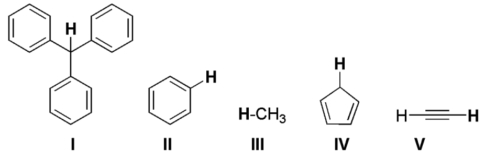
With respect to the compounds $I-V$, choose the correct statement($s$).

$(A)$ The acidity of compound $I$ is due to delocalization in the conjugate base.

$(B)$ The conjugate base of compound IV is aromatic.

$(C)$ Compound II becomes more acidic, when it has a $- NO _2$ substituent.

$(D)$ The acidity of compounds follows the order $I > IV > V > II > III$.