MCQ
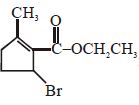
$IUPAC$ name of the compound (figure)
  • A
    Ethyl $-2-$ bromo $-5-$ methylcyclopent $-1-$ ene carboxylate
  • B
    $5-$ Bromoethyl $-2-$ methylcyclopentenecarboxylate
  • Ethyl $-5-$ bromo $-2-$ methylcyclopentenecarboxylate
  • D
    Ethyl $-5-$ bromo $-2-$ methylcyclopent $-2-$ enecarboxylate

Answer

Correct option: C.
Ethyl $-5-$ bromo $-2-$ methylcyclopentenecarboxylate
c

Need a full question paper?

Generate a complete, print-ready paper with questions like this in minutes — across 16+ boards, with answer keys.

Start Generating Free

Similar questions

An organic compound $C_xX_YO_z$ on complete combustion provides equivolume of products $CO_2(g)$ and $H_2O(g)$ which is individually double the volume of organic compound taken. In the process volume of oxygen consumed is same as volume of $CO_2$ produced and liberated heat during combustion is $500 \ kcal/mole$ at constant pressure and at $500\ K$. Formula of organic compoun  & $\Delta U$ for reaction will be -
Which of following reaction does not involve either oxidation or reduction
Number of $\pi$ electrons present in naphthalene is :
For complete combustion of ethene.

$C _2 H _4( g )+3 O _2( g ) \rightarrow 2 CO _2( g )+2 H _2 O ( l )$ the amount of heat produced as measured in bomb calorimeter is $1406\,kJ\,mol { }^{-1}$ at $300\,K$. The minimum value of $T \Delta S$ needed to reach equilibrium is $(-).......\,kJ$. (Nearest integer) Given : $R =8.3\,JK ^{-1} mol ^{-1}$

The kinetic energy of an electron in the second Bohr orbit of a hydrogen atom is equal to $\frac{\mathrm{h}^{2}}{\mathrm{xma}_{0}^{2}}$. The value of $10 \mathrm{x}$ is ........ . $\left(\mathrm{a}_{0}\right.$ is radius of Bohr's orbit) (Nearest integer) [Given : $\pi=3.14]$
To check the principle of multiple proportions, a series of pure binary compounds $\left(P_m Q_n\right)$ were analyzed and their composition is tabulated below. The correct option($s$) is(are)

Compound Weight $\%$ of $P$ Weight $\%$ of $Q$
$1$ $50$ $50$
$2$ $44.4$ $55.6$
$3$ $40$ $60$

$(A)$ If empirical formula of compound $3$ is $P_3 Q_4$, then the empirical formula of compound $2$ is $P_3 Q_5$.

$(B)$ If empirical formula of compound $3$ is $P _3 Q _2$ and atomic weight of element $P$ is $20$ , then the atomic weight of $Q$ is $45$ .

$(C)$ If empirical formula of compound $2$ is $PQ$, then the empirical formula of the compound $1$ is $P _5 Q _4$.

$(D)$ If atomic weight of $P$ and $Q$ are $70$ and $35$ , respectively, then the empirical formula of compound $1$ is $P _2 Q$.
The ionisation constant of acetic acid is $1.8 \times 10^{-5}$. The concentration at which it will be dissociated to $2\%$, is
Which can act as oxidizing as well as reducing agent?
The property by virtue of which a compound can turn the plane polarised light is known as
Which of the following compound is achiral ?