MCQ
$IUPAC$ name of the compound is $C{H_3} - CH = \mathop {\mathop {C - C{H_3}}\limits_{|\,\,\,\,\,\,\,\,\,\,\,\,\,\,} }\limits_{C{H_2} - C{H_2}} $
  • A
    $2-$ ethyl $-2-$ butene
  • B
    $3-$ ethyl $-2-$ butene
  • C
    $3-$ Methyl $-3-$ pentene
  • $3-$ methyl $-2-$ pentene

Answer

Correct option: D.
$3-$ methyl $-2-$ pentene
d
It’s obvious.

Need a full question paper?

Generate a complete, print-ready paper with questions like this in minutes — across 16+ boards, with answer keys.

Start Generating Free

Similar questions

If for a certain reaction $\Delta_{r} H$ is $30 \;kJ \;mol ^{-1}$ at $450 \;K ,$ the value of $\Delta_{r} S \left(\right.$ in $\left. J K ^{-1} mol ^{-1}\right)$ for which the same reaction will be spontaneous at the same temperature is
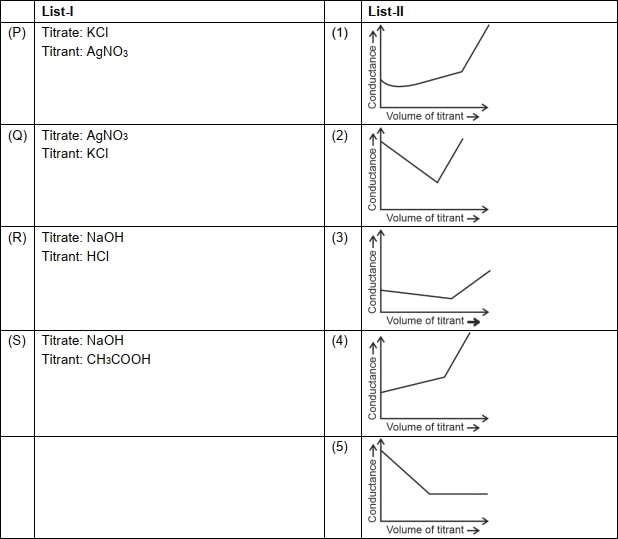
In a conductometric titration, small volume of titrant of higher concentration is added stepwise to a larger volume of titrate of much lower concentration, and the conductance is measured after each addition.

The limiting ionic conductivity ( $\Lambda 0$ ) values (in $mS m ^2 mol ^{-1}$ ) for different ions in aqueous solutions are given below:

Ions $Ag ^{+}$ $K ^{+}$ $Na ^{+}$ $H ^{+}$ $NO _3^{-}$ $CI ^{-}$ $SO _4^{2-}$ $OH ^{-}$ $CH_3COO ^{-}$
$\Lambda_0$ $6.2$ $7.4$ $5.0$ $35.0$ $7.2$ $7.6$ $16.0$ $19.9$ $4.1$

For different combinations of titrates and titrants given in $List-l$, the graphs of 'conductance' versus 'volume of titrant' are given in $List-II$.

Match each entry in $List-I$ with the appropriate entry in $List-II$ and choose the correct option.

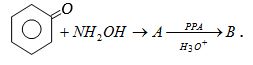
The product ‘$B$’ is
Which of the following have $3C-2e^-$ bond

$I.\, Al_2Cl_6\,\,\, II.\, B_2H_6\,\,\, III.\, Fe_2Cl_6\,\,\, IV.\, Si_2H_6$

The molecular weight of $NaCl$ determined by osmotic pressure method will be
Nitrates of all metals are
The decomposition of hydrogen peroxide is an example of
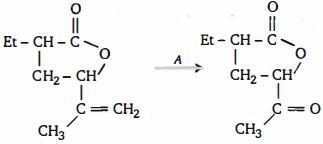
Reagent $(A)$ in the reaction is
Out of the following 0.1 molal aqueous solutions which will have maximum freezing point?
$200\, mL$ of an aqueous solution of a protein contains its $1.26\, g.$ The osmotic pressure of this solution at $300\, K$ is found to be $2.57 \times 10^{-3}$ bar. The molar mass of protein will be  .........$g\, mol^{-1}$

$(R = 0.083 \,L\, bar \,mol^{-1}\, K{-1})$