MCQ
$IUPAC$ name of the following compound $C{H_3} - C{H_2} - \mathop {CH - C{H_2}}\limits^{\mathop {O\,\,\,\,\,\,\,}\limits_{/\,\,\,\,\,\backslash \,\,\,\,\,\,\,} } $ is
- ✓$1, 2-$ epoxy butane
- BEthyl methyl ether
- CKeto pentanone
- DNone of these
$\mathop C\limits_4 {H_3} - \mathop C\limits_3 {H_2} - \mathop {\mathop C\limits_2 H - \mathop C\limits_1 {H_2}}\limits^{\mathop {O{\kern 1pt} {\kern 1pt} {\kern 1pt} {\kern 1pt} {\kern 1pt} {\kern 1pt} {\kern 1pt} }\limits_{/{\mkern 1mu} {\mkern 1mu} {\mkern 1mu} {\mkern 1mu} {\mkern 1mu} {\mkern 1mu} {\mkern 1mu} {\mkern 1mu} {\mkern 1mu} {\mkern 1mu} \backslash {\mkern 1mu} {\mkern 1mu} {\mkern 1mu} {\mkern 1mu} {\mkern 1mu} {\mkern 1mu} {\mkern 1mu} {\mkern 1mu} {\mkern 1mu} {\mkern 1mu} {\mkern 1mu} {\mkern 1mu} {\mkern 1mu} {\mkern 1mu} } } $
Generate a complete, print-ready paper with questions like this in minutes — across 16+ boards, with answer keys.
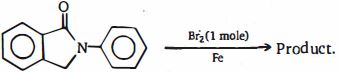
$(i)$ forms aldehydes on ozonolysis followed by the hydrolysis.
$(ii)$ when vaporized completely $1.53\, \mathrm{~g}$ of $\mathrm{A}$, gives $448\, \mathrm{~mL}$ of vapour at $STP.$
The number of carbon atoms in a molecule of compound $A$ is ...... .
$C{H_2} = C{H_2}\xrightarrow{{HBr}}X\xrightarrow{{{\text{Hydrolysis}}}}Y\mathop {\xrightarrow{{N{a_2}C{O_3}}}}\limits_{{I_2}{\text{ excess}}} Z$