MCQ
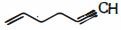
$IUPAC$ name will be
  • A
    Hex $-5-$ en $-1-$ yne
  • Hex $-1-$ en $-5-$ yne
  • C
    Hex $-6-$ en $-1-$ yne
  • D
    Hex $-1-$ en $-6-$ yne

Answer

Correct option: B.
Hex $-1-$ en $-5-$ yne
b

Need a full question paper?

Generate a complete, print-ready paper with questions like this in minutes — across 16+ boards, with answer keys.

Start Generating Free

Similar questions

Cl + Cl → Cl2​, this is an example for __________.
$B$ has a smaller first ionization enthalpy than $Be$. Consider the following statements :

$(I)$ It is easier to remove $2 \mathrm{p}$ electron than $2 \mathrm{s}$ electron

$(II)$ $2 \mathrm{p}$ electron of $\mathrm{B}$ is more shielded from the nucleus by the inner core of electrons than the $2 s$ electrons of $Be.$

$(III)\; 2 s$ electron has more penetration power than $2 \mathrm{p}$ electron.

$(IV)$ atomic radius of $\mathrm{B}$ is more than $\mathrm{Be}$

(Atomic number $\mathrm{B}=5, \mathrm{Be}=4$ )

The correct statements are
$1-$butyne reacts with cold alkaline $KMn{O_4}$ to produce
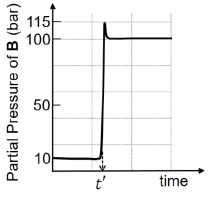
Consider the reaction $A \rightleftharpoons B$ at $1000 K$. At time $t ^{\prime}$, the temperature of the system was increased to $2000 K$ and the system was allowed to reach equilibrium. Throughout this experiment the partial pressure of $A$ was maintained at $1$ bar. Given below is the plot of the partial pressure of B with time. What is the ratio of the standard Gibbs energy of the reaction at $1000 K$ to that at $2000 K$ ?
The name of $Cl{H_2}C - \mathop {\mathop C\limits_{|\,\,} }\limits_{Br} = \mathop {\mathop C\limits_{|\,\,} }\limits_{Br} - C{H_2}Cl$ according to $IUPAC$ nomenclature system is :
What is the solubility of calcium fluoride in a saturated solution, if its solubility product is $3.2 \times {10^{ - 11}}$
In a one litre closed container $4\, moles$ of $PCl_5$ are heated and $80\%$ $PCl_5$ remains undissociated at equilibrium then the value of equilibrium constant is
The probability of finding an electron in the $p_x$ orbital is
For $Li^{+2}$ ion, $r_2 : r_5$ will be
A flask contains a mixture of isohexane and $3 -$ methylpentane. One of the liquids boils at $63^{\circ} \mathrm{C}$ while the other boils at $60^{\circ} \mathrm{C} .$ What is the best way to seprate the two liquids and which one will be distilled out first?