MCQ
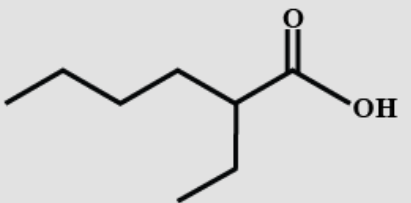
$\text{IUPAC}$ naming of the compound is:
  • A
    $3-$octanoic acid
  • B
    octane$-3-$oic acid
  • $2-$ethylhexanoic acid
  • D
    $3-$ethylhexanoic acid

Answer

Correct option: C.
$2-$ethylhexanoic acid

Need a full question paper?

Generate a complete, print-ready paper with questions like this in minutes — across 16+ boards, with answer keys.

Start Generating Free

Similar questions

The major product of the following reaction is:

$CH _{3} CH _{2} CH = CH _{2}$ $\xrightarrow[{Rh\,\,catalyst}]{{{H_2}/CO}}$
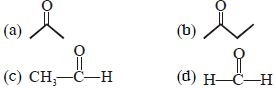
Which of the following gives positive test with $2, 4-DNP$
The outer most electronic configuration of the most electronegative element is:
A gaseous mixture contains equal masses of dihydrogen gas, dioxygen gas and methane gas at a total pressure of $380\ torr$. The partial pressure of methane gas is ........... $torr$.
When $C{H_3}C{H_2}CHC{l_2}$ is treated with $NaN{H_{2,}}$ the product formed is
When an inorganic compound reacts with $SO_2$ in aqueous medium, produces $(A).$ $(A)$ on reaction with $Na_2CO_3,$ gives compound $(B)$ which with sulphur, gives a substance $(C)$ used in photography. Compound $(C)$ is
Total number of lone pair of electrons in $XeOF_4$ is
For a reaction $2A + B \to $ Products, doubling the initial concentration of both the reactants increases the rate by a factor of $8$, and doubling the concentration of $+B$  alone doubles the rate. The rate law for the reaction is
Ethanol cannot be dried by anhydrous $CaCl_2$ due to formation of the following solvated product
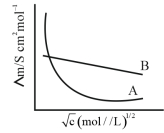
Following figure shows dependence of molar conductance of two electrolytes on concentration. $\Lambda \stackrel{0}{ m }$ is the limiting molar conductivity.The number of Incorrect statement(s) from the following is $...........$

$(A)$ $\Lambda \stackrel{0}{ m }$ for electrolyte $A$ is obtained by extrapolation

$(B)$ For electrolyte B, vx $\Lambda m$ vs $\sqrt{ c }$ graph is a straight line with intercept equal to $\Lambda \stackrel{0}{ m }$

$(C)$ At infinite dilution, the value of degree of dissociation approach zero for electrolyte $B$.

$(D)$ $\Lambda \stackrel{0}{ m }$ for any electrolyte $A$ or $B$ can be calculated using $\lambda^{\circ}$ for individual ions.