Question
Just as precise measurements are necessary in science, it is equally important to be able to make rough estimates of quantities using rudimentary ideas and common observations. Think of ways by which you can estimate the following (where an estimate is difficult to obtain, try to get an upper bound on the quantity): The mass of an elephant.
Answer

Consider a ship of known base area floating in the sea. Measure its depth in sea $\left(\right.$ say $\left.\mathrm{d}_1\right)$. Volume of water displaced by the ship, $\mathrm{Vb}=\mathrm{Ad}_1$ Now, move an elephant on the ship and measure the depth of the ship ( $\mathrm{d}_2$ ) in this case. Volume of water displaced by the ship with the elephant on board, $\mathrm{V}_{\mathrm{be}}=\mathrm{Ad}_2$ Volume of water displaced by the elephant $=A d_2-A d_1$ Density of water $=D$ Mass of elephant $=A D\left(d_2-d_1\right)$

Need a full question paper?

Generate a complete, print-ready paper with questions like this in minutes — across 16+ boards, with answer keys.

Start Generating Free

Similar questions

Distinguish between static friction, limiting friction and kinetic friction. How do they vary with the applied force, explain by diagram.
Though India now has a large base in science and technology, which is fast expanding, it is still a long way from realising its potential of becoming a world leader in science. Name some important factors, which in your view have hindered the advancement of science in India.
Two particles located at a point begin to move with velocities $4m s^{-1}$ and $1m s^{-1}$ horizontally in opposite directions. Determine the time when their velocity vectors become perpendicular. Assume that the motion takes place in a uniform gravitational field of strength g.
A body is projected vertically from the surface of the earth with a velocity equal to half the escape velocity. What is the maximum height reached by the body?
What is a second's pendulum? How much is its length on the surface of moon?
Consider a head-on collision between two particles of masses $m_1$ and $m_2$. The initial speeds of the particles are $u_1$ and $u_2$ in the same direction. The collision starts 2 at t = 0 and the particles interact for a time interval $\triangle\text{t}.$ During the collision, the speed of the first particle varies as.$\text{v}(\text{t})=\text{u}_1+\frac{\text{t}}{\triangle\text{t}}(\text{v}_1-\text{u}_1).$
Find the speed of the second particle as a function of time during the collision.
We have valence electrons and conduction electrons in a semiconductor. Do we also have 'valence holes' and 'conduction holes'?
A source of sound is coming towards a stationary observer with a constant velocity. Deduce the formula for the apparent frequency heard by observer.
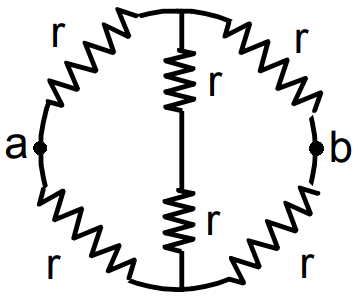
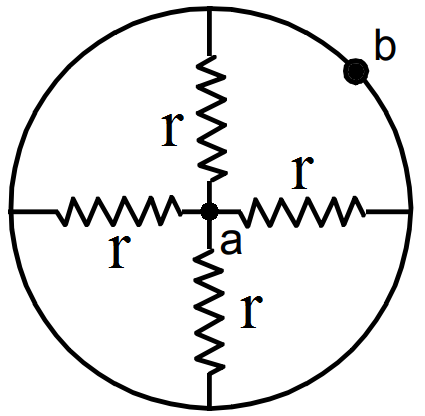
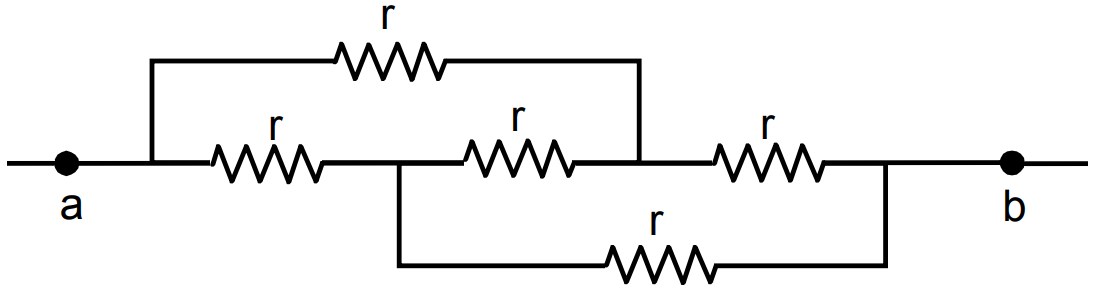
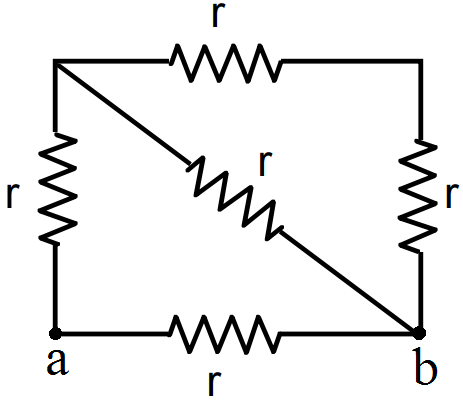
Find the equivalent resistances of the networks shown in the figure. between the points $a$ and $b.$
  1.  
  1.  
  1.  
  1.  
  1.  
A parallel-plate capacitor of plate-area A and plate separation d is joined to a battery of emf $\in$ and internal resistance R at t = 0. Consider a plane surface of area $\frac{\text{A}}{2}$ parallel to the plates and situated symmetrically between them. Find the displacement current through this surface as a function of time.