Question
Justify the statements. If the answer is false, change the underlined word(s) to make the statement true.
(i) The DNA molecule is double stranded and the RNA molecule is single stranded.
Answer:

  1. DNA as the genetic material has to be chemically and structurally stable.
  2. It should be able to generate its replica.
  3. Sugar-phosphate backbone and complementary base pairing between the two strands, give stability to DNA.
  4. Both the strands of DNA act as template for synthesis of their complementary strands. This allows accurate replication of DNA.
  5. Single stranded RNA can be folded to form complex structures and perform specific functions such as synthesis of proteins.

(ii) The process of translation occurs at the ribosome.
Answer

  1. Translation is the process in which sequence of codons of m-RNA is decoded and accordingly amino acids are added in specific sequence to form a polypeptide on ribosomes.
  2. Ribosome has one binding site for m-RNA. It orients m-RNA molecule in such a way that all the codons are properly read.
  3. Ribosome has three binding sites for t-RNA : P-site (peptidyl t-RNA-site), A-site (aminoacyl t-RNA-site) and E-site (exit site).
  4. t-RNAs place the required amino acids in correct sequence and translate the coded message of RNA.
  5. In eukaryotes, a groove which is present between two subunits of ribosomes, protects the polypeptide chain from the action of cellular enzymes and also protects m-RNA from the action of nucleases.
  6. Thus ribosome plays an important role in translation.

(iii) The job of m-RNA is to pick up amino acids and transport them to the ribosomes.
Answer:
The job of t-RNA is to pick up amino acids and transport them to ribosomes. t-RNA is an adapter molecule. It reads the codons of m-RNA and also simultaneously transfer specific amino acid to m-RNA Ribosome complex. It binds with amino acid at its 3′ end.

(iv) Transcription must occur before translation may occur.
Answer:
In prokaryotes, translation can start before transcription is complete, as both these processes occur in the same compartment, i.e. cytoplasm. But in eukaryotes, transcription and processing of hnRNA occurs in nucleus. hnRNA then comes out of the nucleus through nuclear pores and then it is translated at ribosomes in the cytoplasm.

Need a full question paper?

Generate a complete, print-ready paper with questions like this in minutes — across 16+ boards, with answer keys.

Start Generating Free

Similar questions

Draw a diagrammatic sketch of the sectional view of a typical anatropous ovule.
OR
Draw a labelled diagram of the sectional view of a typical anatropous ovule.
Complete the table given below.
CropVarietyResistant to disease
Wheat————–Leaf and stripe rust, Hill bunt
————-Pusa swarnimWhite rust
Cauliflower————–Black rot and Curl blight black rot
ChilliPusa sadabahar—————
Write two differences between spermatogenesis and oogenesis.
Give schematic representation of nitrogen cycle and enlist important steps of this cycle.
Since October 02, 2014 "Swachh Bharat Abhiyan" has been launched in our country.
  1. Write your views on this initiative giving justification.
  2. As a biologist name two problems that you may face while implementing the programme in your locality.
  3. Suggest two remedial methods to overcome these problems.
Write a short note on Behavioural adaptations in animals
How can slash and burn agriculture become environment friendly?
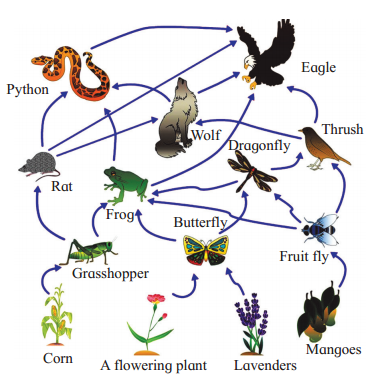
Observe the given food web and answer the questionsImage1. Name the producers in the above web.
2. Name the primary consumers in the above web.
3. Which is an omnivore animal in the above web? Why?
4. Why frog is occupying an important ecological position in this web?
5. From the given food web diagram, give the trophic levels where the eagle is present.
You have a friend whose parents are too indulgent in his/her daily affairs. They think him/her to be still young which makes him/her sad and is upset all the time. As he/she feels that the parents should give him/her opportunity to take independent decision on some issues.
  1. Would you support your friend and why?
  2. Write the characteristics of this age group.
  3. List two curative measures.
Answer the following questions:
Mention the functions of acrosome and middle piece.