MCQ
${K_2}C{r_2}{O_7}$ on heating with aqueous $NaOH$ gives
- ✓$CrO_4^{2 - }$
- B$Cr{(OH)_3}$
- C$C{r_2}O_7^{2 - }$
- D$Cr{(OH)_2}$
Generate a complete, print-ready paper with questions like this in minutes — across 16+ boards, with answer keys.
$(A)$ $H _2 O _2$ in presence of $NaOH$
$(B)$ $Na _2 O _2$ in water
$(C)$ $H _2 O _2$ in presence of $H _2 SO _4$
$(D)$ $Na _2 O _2$ in presence of $H _2 SO _4$
($A$) can also be prepared by reaction of $\mathrm{P}_4$ and $\mathrm{HNO}_3$
($B$) is diamagnetic
($C$) contains one $\mathrm{N}-\mathrm{N}$ bond
($D$) reacts with $\mathrm{Na}$ metal producing a brown gas
$AB \to$ Isothermal expansion
$AC \to$ Adiabatic expansion
Which of the following options is not correct ?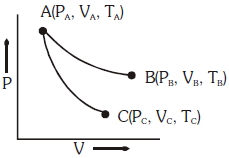
$C{H_3} - C \equiv C - H\xrightarrow{{NaN{H_2}}}\xrightarrow{{C{H_3} - I}}(A)\xrightarrow{{Li/liq\,N{H_2}}}(B)$
$C{H_3} - C \equiv C - H\xrightarrow{{NaN{H_2}}}\xrightarrow{{C{H_3} - I}}(A)\xrightarrow[{Pd.CaC{O_3}}]{{{H_2}}}(C)$