MCQ
$K_2MnO_4$ can be converted into $KMnO_4$ by
  • A
    Passing $CO_2$ gas
  • B
    Passing $Cl_2$
  • C
    Electrolytic oxidation
  • All of these

Answer

Correct option: D.
All of these
d

Need a full question paper?

Generate a complete, print-ready paper with questions like this in minutes — across 16+ boards, with answer keys.
Start Generating Free

Similar questions

In which case van't Hoff factor is maximum (assuming no hydrolysis)?
At $298\, K$, the standard reduction potentials are $1.51\, V$ for $MnO_4^ - \,|\,M{n^{2 + }}$, $1.36\, V$ for $C{l_2}\,|\,C{l^ - }$, $1.07\, V$ for $B{r_2}\,|\,B{r^ - }$ and $0.54\, V$ for ${I_2}\,|\,{I^ - }$. At $pH\, = 3$ , permanganate is expected to oxidize $\left( {\frac{{RT}}{F} = 0.059\,V} \right)$
If the bidentate ligand ethane $1, 2-$ diamine $(en)$ in progressively added in green aqueous solution of $[Ni(H_2O)_6]Cl_2$ in the molar ratios $en : Ni$ as $1 : 1, 2 : 1, 3 : 1$ then their associated spin only magnetic moment (in $B.M.\, unit$) are respectively
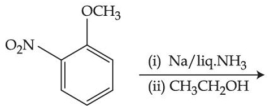
The major product of the following reaction is
Methylamine reacts with HNO2 to form __________.
Which of the following gases when passed through warm dilute solution of ${H_2}S{O_4}$ in presence of $HgS{O_4}$ gives acetaldehyde
The compound $A$ on treatment with $Na$ gives $B$, and with $\mathrm{PCl}_{5}$ gives $\mathrm{C} . \mathrm{B}$ and $\mathrm{C}$ react together to give diethyl ether. $\mathrm{A}, \mathrm{B}$ and $\mathrm{C}$ are in the order
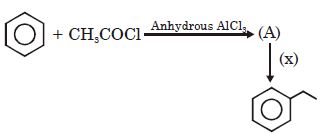
Reagent  $(x)$  can be
The standard reduction potentials at $298\,K$for the following half reactions are given against each

$Zn^{2 + }(aq.) + 2e⇔  Zn(s)$; $→$  $  -0.762$

$Cr^{3 + }(aq) + 3e  ⇔ Cr(s)$;  $→$    $-0.740$

$2H^ +(aq) + 2e⇔  {H_2}(g)$; $→$    $0.00$

$Fe^{3+}(aq) + e  ⇔ Fe^{2+}(aq)$; $→$  $0.770$

Which is the strongest reducing agent

The molecule which does not exhibit strong hydrogen bonding is: