MCQ
${K_3}\left[ {Fe{{(CN)}_6}} \right]$ is called
  • A
    Potassium ferricyanide
  • B
    Red prussiate of potash
  • C
    Potassium hexacyanoferrate (III)
  • All of these

Answer

Correct option: D.
All of these
d
$IUPAC$ name of $K _3\left[ Fe ( CN )_6\right]$ is $Potassium\,\,hexacyanoferrate(III).$ It is also commonly known as Potassium ferricyanide or Red prussiate of Potash.

Need a full question paper?

Generate a complete, print-ready paper with questions like this in minutes — across 16+ boards, with answer keys.
Start Generating Free

Similar questions

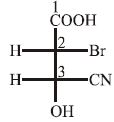
The absolute configurations of the two centers in the following molecule are
$\mathrm{BF}_{3}$ is planar and electron deficient compound. Hybridization and number of electrons around the central atom, respectively are:
Which of the following pair gives same phenyl osazone ?
The volume $(\text { in } \mathrm{mL})$ of $0.125\; \mathrm{M}\; \mathrm{AgNO}_{3}$ required to quantitatively precipitate chloride ions in $0.3\; \mathrm{g}$ of $\left[\mathrm{Co}\left(\mathrm{NH}_{3}\right)_{6}\right] \mathrm{Cl}_{3}$ is $^{\mathrm{M}}\left[\mathrm{Co}\left(\mathrm{NH}_{3}\right)_{6}\right] \mathrm{Cl}_{3}=267.46 \;\mathrm{g} / \mathrm{mol}$ $\mathrm{M}_{\mathrm{AgNO}_{3}}=169.87 \;\mathrm{g} / \mathrm{mol}$
Ionic reactions with organic compounds proceed through:

$(A)$ Homolytic bond cleavage

$(B)$ Heterolytic bond cleavage

$(C)$ Free radical formation

$(D)$ Primary free radical

$(E)$ Secondary free radical

Choose the correct answer from the options given below:

The discovery of neutron becomes very late because
Dissolving $120 \mathrm{~g}$ of urea (mol. wt. $60$) in $1000 \mathrm{~g}$ of water gave a solution of density $1.15 \mathrm{~g} / \mathrm{mL}$. The molarity of the solution is
A solution of polystyrene in benzene contains $10\,g/L$ the equilibrium height of the column of solution having density $0.9\,g/ml$ in the osmometer having capillary rise $11\,cm$ at $27\,^oC$ what is average molar mass of polystyrene (Assume solution is ideal)
Which of the following applies in the reaction,

$C{H_3}CHBrC{H_2}C{H_3}\xrightarrow{{alc.\,KOH}}$

$(i)$ $C{H_3}CH = CHC{H_3}$ (major product)

$(ii)$ $C{H_2} = CHC{H_2}C{H_3}$ (minor product)

An isocyanide on hydrolysis gives