MCQ
$K_4[Fe(CN)_6]$ reacts with ozone to give
- A$Fe_2O_3$
- B$Fe(OH)_2$
- ✓$K_3[Fe(CN)_6]$
- D$KNO_3$
Generate a complete, print-ready paper with questions like this in minutes — across 16+ boards, with answer keys.
$\begin{array}{|l|l|} \hline List\,\,I & List\,\,II \\ \hline (A)\,\,Peroxide & (1)\,\,{C_3}{O_2} \\ \hline (B)\,\,Superoxide & (2)\,\,Pb{O_2} \\ \hline (C)\,\,Dioxide & (3)\,\,K{O_2} \\ \hline (D)\,\,Suboxide & (4)\,\,{H_2}{O_2} \\ \hline \end{array}$
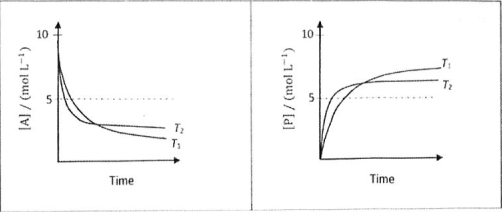
If $T _2> T _1$, the correct statement(s) is (are)
(Assume $\Delta H ^{\ominus}$ and $\Delta S ^{\ominus}$ are independent of temperature and ratio of $\ln K$ at $T _1$ to $\ln K$ at $T_2$ is greater than $T_2 / T_1$. Here $H, S, G$ and $K$ are enthalpy, entropy, Gibbs energy and equillibrium constant, respectively.)
$(A)$ $\Delta H ^{\ominus}<0, \Delta S ^{\ominus}<0$ $(B)$ $\Delta G ^{\ominus}<0, \Delta H ^{\ominus}>0$ $(C)$ $\Delta G ^{\ominus}<0, \Delta S ^{\ominus}<0$ $(D)$ $\Delta G ^{\ominus}<0, \Delta S ^{\ominus}>0$